
THE SERVICES AS-A-SOLUTION PLAYBOOK
The Service Model Transformation
How professional and backoffice outsourcing services firms are evolving from labor-based delivery toward scalable, technology-enabled solution operating models and what the data tells us about where the market is heading.

A Structurally Fragmented Landscape
The U.S. professional & outsourcing services market is massive and almost entirely composed of small businesses. Spanning technology, accounting, and management consulting, the sector counts over 166,930 classified firms across NAICS-defined categories. Public companies represent well below 1% of total establishments, while the overwhelming majority are privately held firms with fewer than 20 employees.
This structural reality is a sea of small, privately owned operators with minimal institutional ownership that makes the landscape worth examining closely for consolidation and tech-enabled strategies.
Revenue per Employee: What the Numbers Reveal
Among early-stage firms with estimated revenues between $5M and $50M, labor efficiency varies significantly. Technology & Systems and Accounting & Payroll both achieve median revenue-per-employee figures around $160K, while HR & Management sits at $120K at median.
But to put these average vs top quartile performer numbers in context, the trajectory of top-quartile private firm performance tells a clear story. (Source: Inc5000 award winners)
That is near-doubling over two decades driven not by sector tailwinds, but by deliberate shifts towards standardization and technology-enabled delivery. What was once elite performance is now a table stake for competitive operators.
è "Revenue labor efficiency is driven more by service model delivery team structure than function — standardized, technology-enabled services achieving scalability well beyond $300K revenue per employee."
The implication: the ceiling isn’t in the service; it's in the model. Firms that standardize workflows and embed technology in their delivery layer can escape the linear headcount-to-revenue trap. The historical arc makes these concrete operators who moved early capture the gains; those who waited are now playing catch-up.
What used to be exceptional ($233k/employee) is now below average. If you’re not moving toward $300k+ level, you’re falling behind and not standing still.
Scale Is the Exception, Not the Rule
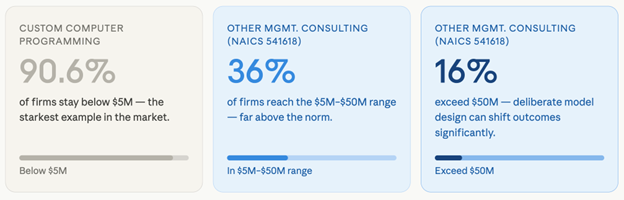
The vast majority of firms never break the $10M threshold. Custom Computer Programming is the starkest example, with 90.6% of firms below $5M. The outlier is Other Management Consulting (NAICS 541618), where 36% of classified firms sit in the $5M–$50M range and 16% exceed $50M — suggesting that deliberate model design can shift outcomes significantly.
The Shift from Labor to Leverage
Service delivery shows clear signs of structural change. The forces cited as drivers are well-documented cloud infrastructure standardizing delivery environments, AI boosting knowledge of worker productivity, and buyers increasingly favoring outcome-based contracts over time-and-materials billing.
Three revenue pricing to service delivery options:
1. Project / Hourly / Custom Services Labor-intensive. Revenue tied directly to headcount. Difficult to scale without proportional hiring.
2. Recurring Managed Services Ongoing operations with defined SLAs. More predictable revenue, stronger client relationships. Partial decoupling of headcount revenue growth.
3. BPaaS / Tech-Enabled Operations Standardized process + platform + recurring delivery. Highest margins, strongest customer lock-in, most scalable.
"As services become more standardized and technology-enabled, firms move from labor-based delivery toward scalable operating models that improve margins and create stronger customer lock-in."
What This Means for Operators and Investors
Three themes emerge from the data in this playbook:
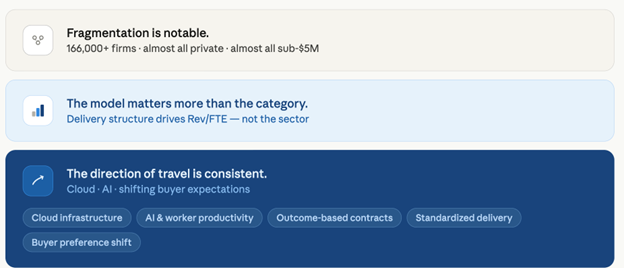
Fragmentation is notable. With over 166,000 classified firms almost all privately held, almost all sub-$5M in the market is highly fragmented with minimal institutional ownership. We believe this structural reality makes it worth examining consolidation and roll-up strategies, though the playbook data alone does not validate specific valuation assumptions or deal with flow outcomes.
The model matters more than the category. The data is clear on this: revenue per employee is driven more by how standardized and tech-enabled a firm's delivery model is than by which sector it operates in. When evaluating firms, model maturity deserves as much attention as top-line revenue.
The direction of travel is consistent. AI plus shifting buyer preferences are all cited as forces pushing toward BPaaS and tech-enabled recurring delivery. We believe firms that move in this direction are better positioned though how quickly the broader market follows remains to be seen.
Why This Matters — In Everyday Terms
🏘️ If you run a services business The way you charge clients is about to matter more than ever. Businesses that keep billing for the hour or per transaction will face growing pressure on rates and margins. Those that shift to recurring, packaged services think subscriptions or outcome-based contracts will grow faster, be more stable, and ultimately be worth more if you ever want to sell.
💼 If you're an investor or buyer There are over 166,000 small services firms out there most privately owned, with most under $5M, and most with no clear succession plan. The data suggests a large, fragmented market were buying and modernizing these businesses is worth exploring. The value isn't just in the revenue it's in upgrading how they operate.
🤖 If you're a client of these firms Expect the services you buy accounting, IT support, HR consulting to change…... AI is making it possible for smaller firms to do more with less, which should mean better service and faster turnaround.
è The direction is clear in the numbers: a fragmented, labor-heavy market being reshaped by cloud, AI, and shifting buyer expectations. The firms and investors who recognize this shift early will be best positioned to define what comes next.
