
ERP in the AI Era: The Seven Findings Reshaping Backoffice Finance
By Charles Bedard, Corporate Development Analyst· Fall 2026
Corporate Development Analyst Briefing of the partner ecosystems, product strategy, and M&A across the 10 platforms that run backoffice finance — and the AI-native challengers coming for them.
10 Incumbent platforms covered | 10 AI-native challengers, founded 2021+ | Software User → Copilot Agent The 2023–2025 product shift | Roll-up, not combo convergence The current M&A pattern |
IN THIS REPORT
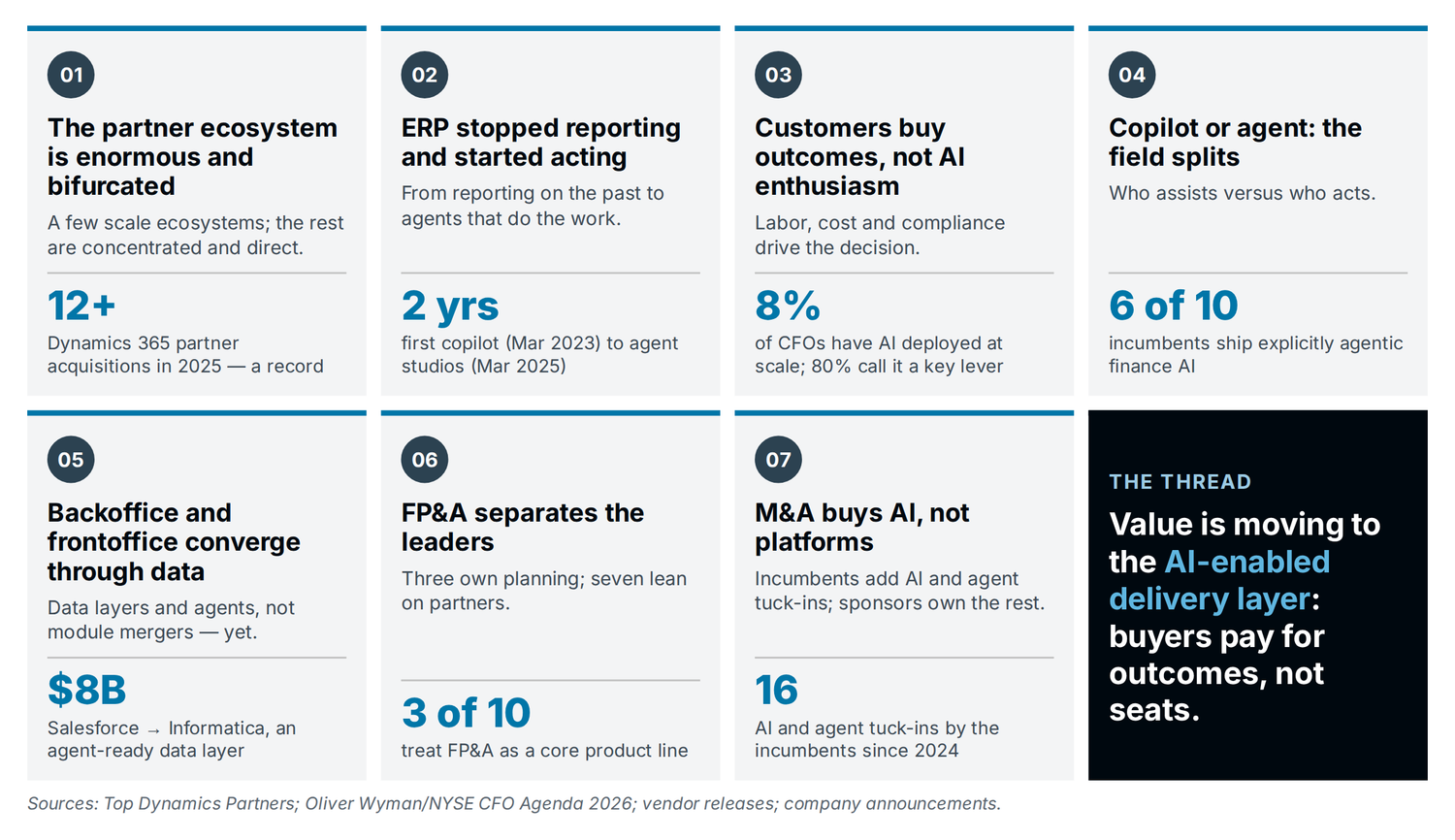
Seven findings
The partner ecosystem is enormous, uneven, and bifurcated.
Update across the top 10 platforms
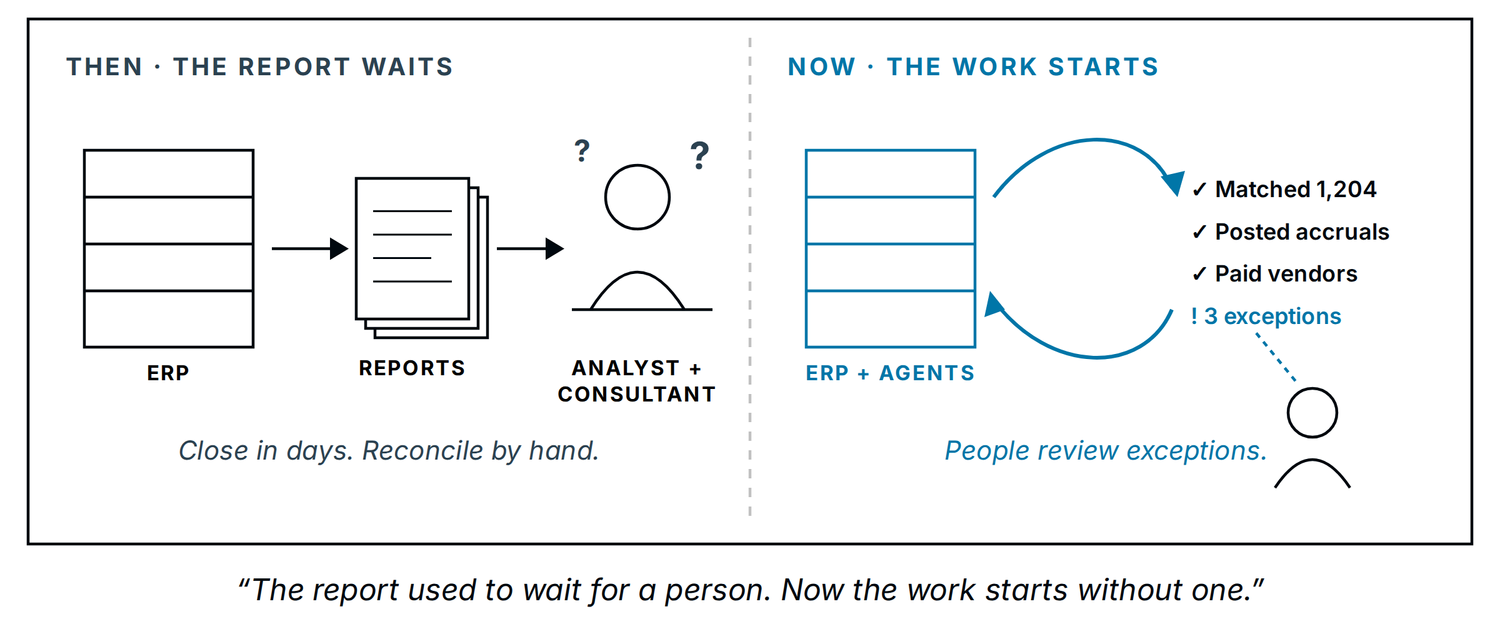
Pre-AI ERP was a reporting layer; AI-era ERP reconciles automatically.
The pre 2020 SaaS vs current AI era timeline from chat assistant to autonomous agent orchestration to outcomes.
Customers buy outcomes, not AI enthusiasm.
Labor economics, plus cost pressures, and rising compliance mandates driving decisions.
AI product strategy is splitting into "copilot" and "agentic" camps.
A vendor-by-vendor read on who's actually shipping autonomous execution.
Backoffice and frontoffice are converging — through data layers, not module mergers yet.
Workday Data Cloud, SAP's CX push, Oracle's Unity CDP.
FP&A is a real differentiator for three vendors — and an afterthought for the rest.
Who owns planning natively, and who leans on partners.
The M&A story is undecided….
Sponsors already own several "incumbents"; numerous small undisclosed tuck-ins.
Included below: the Top 10 AI-Era ERP landscape, the 10 incumbent platforms at a glance, a five-company challenger deep-dive, the 2026 investment exhibit and a partner-ecosystem snapshot. The full M&A tables are in the downloadable briefing.
Exhibit A: Top 10 AI-Era ERP Platforms (Founded 2021+)
Companies are building AI-native alternatives to the general ledger — all launched in the last five years. Five are covered in a full deep-dive analyst briefing; the other five are newer or thinner on disclosed data and are listed here for the landscape view.
| Company | Founded | Funding to date | Latest round |
| Rillet | 2021 | ~$208.5M | $100M Series C, Aug. 2026 |
| Tailor | 2021 | $37M+ | $37M Series A, Nov. 2025 |
| Doss | 2022 | $73M (sum of disclosed) | $55M Series B, Mar. 2026 |
| Keel | 2021–2022 | $6M (seed only) | $6M seed, Oct. 2024 |
| Light | 2022 | $43M | $30M Series A, Sept. 2025 |
| Campfire | 2023 | $100M+ (vendor-stated) | $65M Series B, Oct. 2025 |
| Nominal | 2023 | ~$29.2M | $20M Series A, Jul. 2025 |
| GoodDay Software | 2023 | $13.5M | $7M seed ext., Jan. 2026 |
| DualEntry | 2024 | $100M+ (vendor-stated) | $90M Series A, Oct. 2025 |
| Viewz | ~2025 | $7M | $7M seed, May 2026 |
Sorted by founding year.
.
Exhibit B: The 10 Incumbent ERP Platforms
| Platform | Revenue est. | Employees | Founded | Ownership |
| SAP (S/4HANA + Business One) | $43.14B | 149,370 | 1972 | Public |
| Epicor | $1.10B | 5,709 | 1972 | PE platform (CD&R and CVC, joint) |
| Microsoft Dynamics 365 | $331.84B (Microsoft Corp.) | 234,839 | 1975 | Public |
| Oracle Fusion Cloud ERP | $71.78B (Oracle Corp.) | 205,434 | 1977 | Public |
| Deltek | n/d (Roper subsidiary) | 4,899 | 1981 | Public subsidiary (Roper) |
| NetSuite | n/d (Oracle subsidiary) | 15,201 | 1998 | Public subsidiary (Oracle) |
| Sage Intacct | $2.63B (Sage Group plc) | 15,771 | 1999 | Public |
| Infor | ~$3.2B (2019, last disclosed) | 21,968 | 2002 | Private subsidiary (Koch Equity Dev.) |
| Workday Financial Mgmt | $10.15B | 25,165 | 2005 | Public |
| Acumatica | $296.46M | 807 | 2006 | PE platform (Vista Equity Partners) |
Sorted by year founded. Corporate-parent-level data, not platform-specific revenue; Microsoft and Oracle figures are whole-company scale. Sage Intacct founded 1999 (Sage acquired it in 2017); Infor has not reported revenue since Koch took full ownership in 2020; Deltek is a Roper subsidiary (acquired 2016, $2.8B); CVC joined CD&R as a joint owner of Epicor in Oct 2024.
Seven findings at a glance
Finding #1: The partner ecosystem is enormous, uneven, and bifurcated.
Size matters.
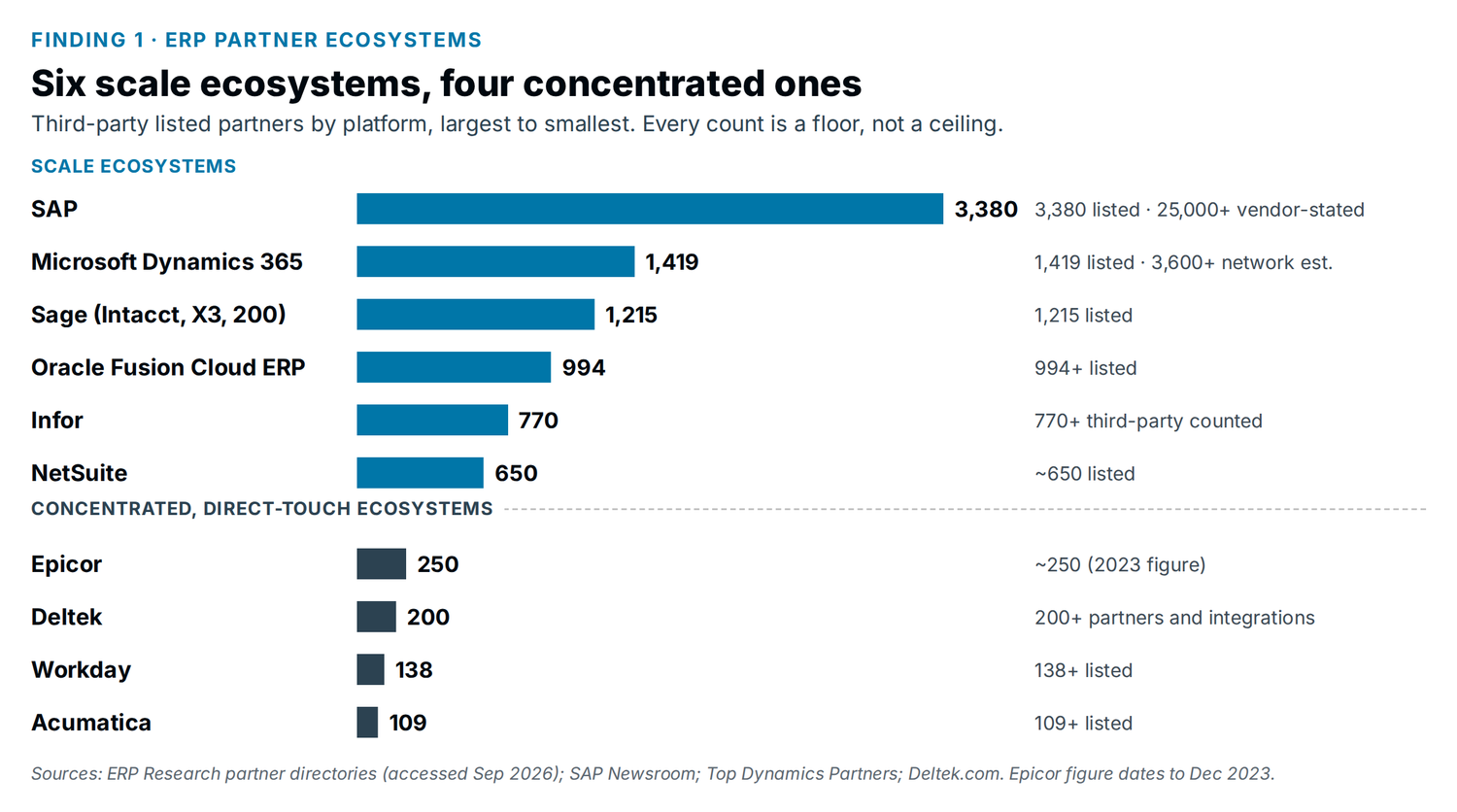
SAP sits alone at scale: SAP itself claims "over 25,000 partners and SAP PartnerEdge open ecosystem members" across its full portfolio, while the independent directory ERP Research lists 3,380 SAP partners under an ERP-specific filter.
Microsoft Dynamics 365 shows a similar split — 1,419 firms listed on ERP Research against a broader Microsoft Partner Network estimate of "3,600+" from a channel-focused publisher.
NetSuite (~650 listed), Oracle Fusion Cloud ERP (994+), Sage (1,215, spanning Intacct/X3/Sage 200), and Infor (770+ third-party-counted); versus Epicor ("250+ Authorized Partners" published in 2023), Workday (138+), Acumatica (109+), and Deltek ("200+ partners and integrations," a blended figure) have the smallest disclosed ecosystems — consistent with more concentrated, direct-touch sales motions.
Two recent trends stand out.
Consolidation is hitting the Microsoft Dynamics channel: 2025 set a record with 12+ verified partner acquisitions, topping 2021's prior high of 10, led by Bain Capital's roughly $1.1B purchase of HSO — the largest disclosed MSFT D365 roll-up to date.
Vertical specialization is now an explicit vendor priority: an IDC study commissioned by Sage (September 2025) found about 70% of "high-performing" partners now focus on micro-verticals, and Sage responded in November 2025 with an AI Developer Solutions program letting partners build certified AI agents on an MCP-based gateway, starting with Intacct.
ERP Partner Ecosystem Snapshot
| Platform | Partner count |
| SAP | 25,000+ (vendor) / 3,380 (3rd-party) |
| Microsoft Dynamics 365 | 1,419 listed (network est. 3,600+) |
| Sage Intacct (+X3, Sage 200) | 1,215 listed |
| Oracle Fusion Cloud ERP | 994+ listed |
| Infor | 770+ 3rd-party-counted |
| NetSuite | ~650 listed |
| Epicor | ~250+ (stale, Dec. 2023) |
| Deltek | 200+ (blended) |
| Workday | 138+ listed |
| Acumatica | 109+ listed |
Finding #2: Pre-AI ERP was a reporting layer versus AI-era ERP acts on its own
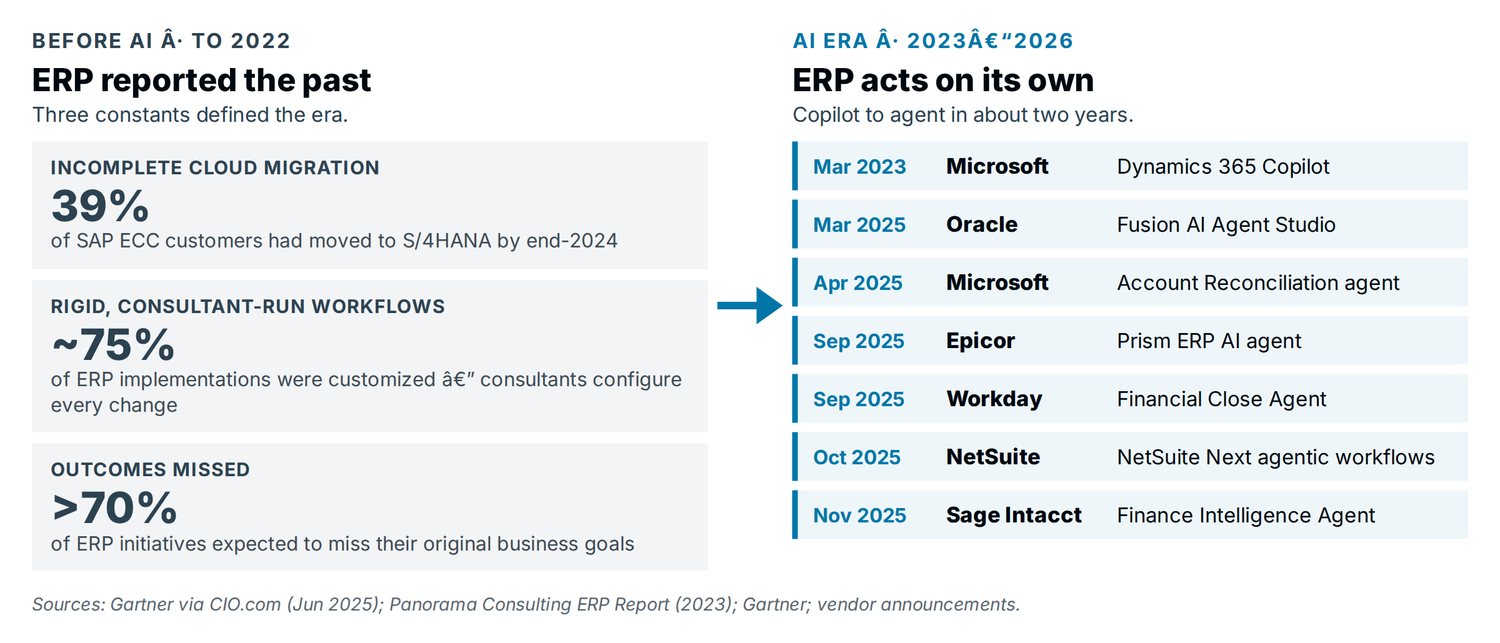
Pre AI era was defined by three constants:
Incomplete cloud migration and long, expensive rollouts (more than a quarter of organizations exceeded their implementation budget
Rigid workflows required consultants to change/configure (manage manual reconciliation for example)
Lack of outcomes
The AI-era shift is here:
Oracle's Fusion AI Agent Studio let customers build and orchestrate autonomous agents inside Fusion Apps,
Microsoft: the Dynamics 365 Finance Account Reconciliation agent (public preview April 2025; generally available September 2026) automates period-end matching and routes only the exceptions to people.
Epicor launched Prism, billed as "the industry's first ERP AI agent."
Workday added a Financial Close Agent, with Cost & Profitability and Financial Test agents, to Illuminate (September 2025).
NetSuite Next (SuiteWorld, October 2025) brought agentic workflows for payment proposals and reconciliations, plus SuiteAgent frameworks for partners.
Sage launched the Finance Intelligence Agent for Sage Intacct (November 2025), answering plain-language finance questions by routing them to the right agents and data.
| Year | Vendor | Milestone |
| 2023 | Microsoft | Dynamics 365 Copilot (Mar. 6) |
| 2023 | SAP | Joule announced (Sept. 26) |
| 2023 | NetSuite | Text Enhance / GenAI tools (Oct., SuiteWorld) |
| 2024 | Sage | Sage Copilot (Mar. 1) |
| 2024 | Deltek | Deltek Dela (Apr. 22) |
| 2024 | Infor | Infor GenAI (Apr. 9) |
| 2024 | Workday | Workday Illuminate (Sept. 17) — agent-framed, not chat |
| 2025 | Oracle | Fusion AI Agent Studio (Mar. 20) — build/orchestrate agents |
| 2025 | Epicor | Prism, "industry's first ERP AI agent" (Sept. 3) |
Finding #3: Customers buy outcomes, not AI enthusiasm alone
| Driver | Data point |
| Finance labor economics | 30% of CFOs plan headcount cuts in 3 yrs; only 8% have deployed AI at scale |
| Compliance mandates | France e-invoicing mandate starts Sept. 1, 2026 |
| Market growth | ERP market: $77.1B (2025) → $157.1B by 2033 (9.5% CAGR) |
The evidence that buyers now choose on outcomes:
AI now rivals cost as the reason to switch: 41% of finance leaders cite better AI-native alternatives as a reason to switch, the same share that cite cost; 28% are very likely to replace finance tools within 12 months for AI reasons (SpendHound/YipitData survey, Sep 2026).
Buyers want to pay for usage, not seats: 39% of software buyers prefer pay-as-you-go pricing (G2, May 2025), and Workday moved AI to consumption with Flex Credits (Oct 2025).
Reviews reward outcomes: in an analysis of 500+ ERP reviews, buyers rank unified data and real-time reporting first, and missing AI is one of the first complaints (G2, May 2026).
Named switches cite close speed and cost: OnlineMedEd moved from NetSuite to Rillet, saving 20 hours on close and reporting at 50% lower cost (Rillet case study); Campfire says it has moved customers off NetSuite, Sage Intacct and SAP.
Finding #4: AI product strategy is splitting into "copilot" and "agentic" camps
Assistant or Agent of Action?
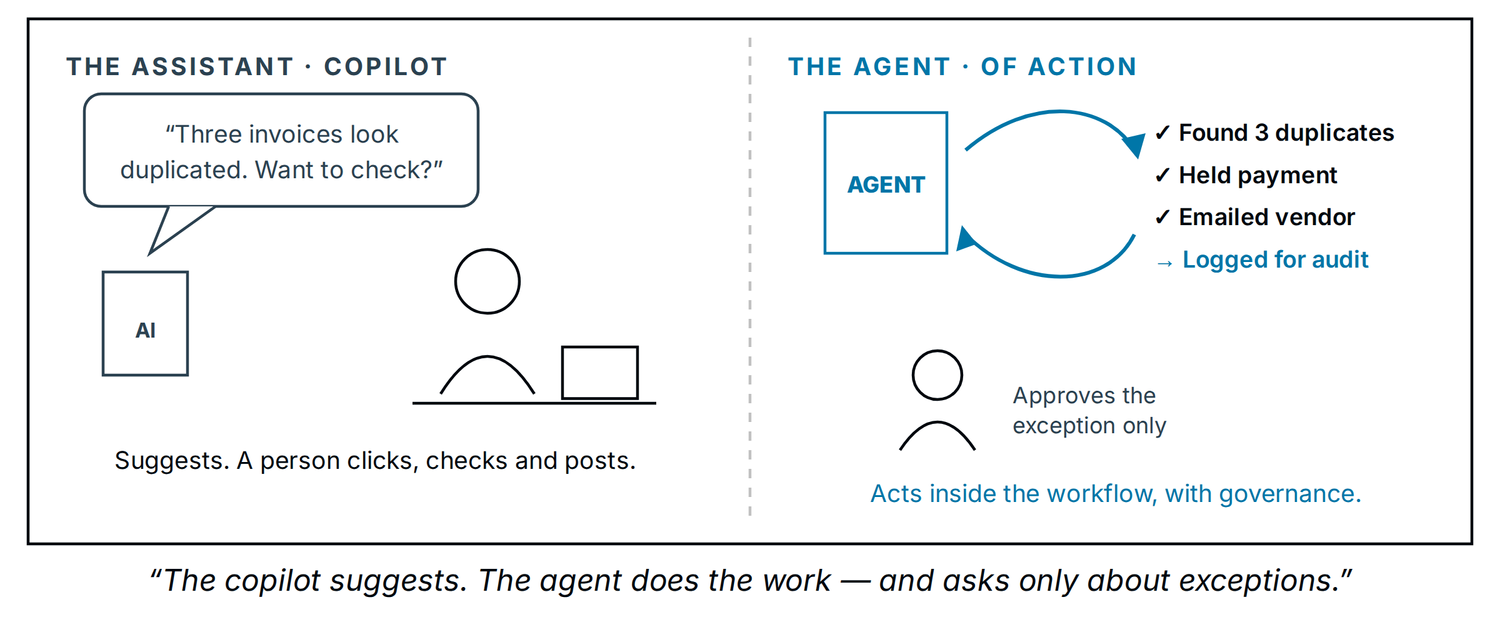
Assistant or Agent of Action?
| Vendor | Flagship AI product | Copilot or agentic | Latest announcement |
| NetSuite | AI Connector Service / MCP Apps | Bring-your-own-model | Mar. 2026 |
| SAP | Joule / Joule Agents | Agentic | Jul. 2026 |
| Oracle | Fusion Agentic Applications | Agentic | Mar. 2026 |
| Microsoft | Copilot in D365 + first-party agents | Both (bifurcated) | Jun. 2026 |
| Workday | Illuminate | Agentic | Sept. 2025 |
| Sage | Sage Copilot | Copilot (agentic ambition ahead) | Nov. 2025 |
| Acumatica | AI Assistant | Copilot only (explicit) | Mar. 2026 |
| Epicor | Prism | Agentic | Sept. 2025 |
| Infor | Industry AI Agents | Agentic | Oct. 2025 |
| Deltek | Dela | Agentic | Nov. 2025 |
Pricing disclosed by only two vendors: Acumatica (paid AI Units add-on) and Microsoft (bundled within existing licenses).
SAP's Joule and Joule Agents are explicitly pitched as agentic — "agents run the business" — with a stated roadmap of 200 agents and 50+ assistants (vendor-self-reported).
Oracle's Fusion Agentic Applications explicitly contrast themselves against copilots: "execute in real time, at enterprise scale, with full governance."
Microsoft is bifurcated — Copilot in Dynamics 365 (assistive) alongside discrete first-party agents.
Workday Illuminate is explicitly agentic; - 1.7 billion AI actions delivered across the platform in fiscal year 2026.
Epicor Prism, Infor's Industry AI Agents, and Deltek's Dela orchestrator are all explicitly agentic.
Versus
Acumatica is the one vendor explicit about NOT being agentic: its own FAQ states the AI Assistant "cannot perform actions, update records, or access data outside of the configured inquiries."
Finding #5: Backoffice and frontoffice are converging — mostly through data layers, not module mergers yet
Workday's clearest move is Workday Data Cloud (announced September 2025), built to connect HCM/Finance data with external customer and market data.
SAP is converging from the CX side, pushing its Customer Experience suite deeper into the ERP fabric.
Oracle shows the most explicit customer-data-platform convergence — Unity CDP inside Fusion Cloud CX, escalating in April 2026 with Fusion Agentic Applications for CX spanning five agent workspaces.
Salesforce bought m3ter (June 2026) to meter and bill usage inside its revenue cloud, after launching Agentforce for Revenue, one agent spanning quote, contract, order, invoice and billing (July 2025). The CRM leader is moving into billing.
Microsoft: Business Central's Sales Order Agent turns customer emails into quotes and then ERP sales orders (preview April 2025).
NetSuite Next adds conversational order entry, dynamic pricing and buying inside AI assistants (October 2025): ERP reaching into selling.
Workday bought Pipedream (November 2025), whose 3,000+ connectors let Workday agents act inside CRM and other frontoffice apps; SAP bought Reltio (March 2026) for shared customer and supplier master data.
AI-native ERPs: Rillet and Campfire feed revenue recognition directly from Salesforce and HubSpot contracts, collapsing the CRM-to-ledger handoff.
Microsoft's Dynamics 365 2025 Wave 2 advanced Finance, Sales, and Customer Service in parallel, but frames these as independent enhancements rather than an explicit unification story.
From the M&A perspective, frontoffice adjacent purchase is SAP's completed acquisition of WalkMe (announced June 2024, closed September 2024).
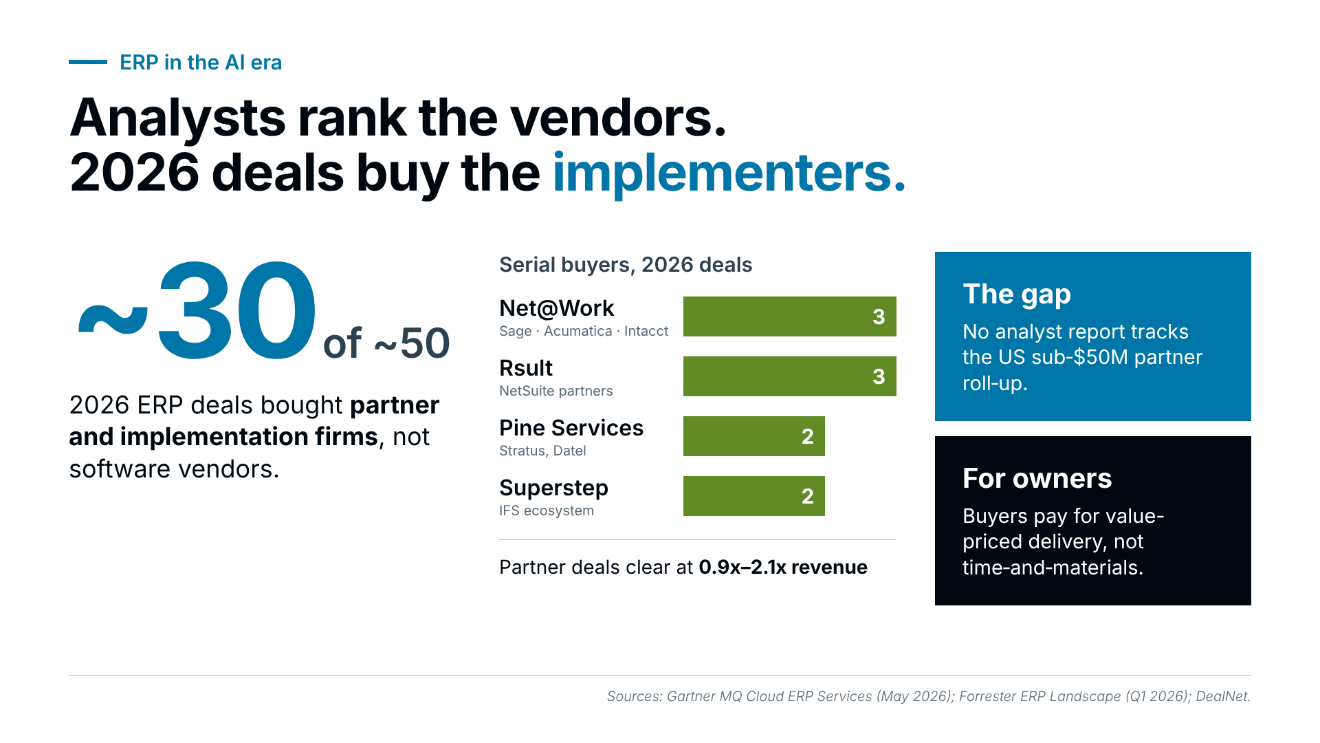
Buying AI M&A
Workday's Sana ($1.1B, closed November 2025)
Evisort (2024) acquisitions are AI-agent and document-intelligence plays
Watch for more direct CRM/RevOps + FinOps + PeopleOp buys.
| Vendor | Move | Date |
| Workday | Workday Data Cloud (HCM/Finance + external customer data) | Sept. 2025 (GA later 2026) |
| SAP | CX suite deepened into ERP fabric + WalkMe acquisition | Jan. 2026 / Sept. 2024 |
| Oracle | Unity CDP in Fusion CX; Fusion Agentic Apps for CX | Sept. 2024 / Apr. 2026 |
| Microsoft | D365 2025 Wave 2 (Finance + Sales + Service in parallel) | Jul. 2025 |
Finding #6: FP&A is a real differentiator for three vendors — and a partner-ecosystem play for the rest
Workday, Oracle, and SAP treat FP&A as a core, AI-invested product line.
Workday Adaptive Planning scales to 500+ dimensions and 70,000+ accounts, with Illuminate providing anomaly detection and predictive forecasting.
Oracle Fusion Cloud EPM added AI-powered automated data aggregation and natural-language root-cause exploration in November 2025.
SAP Analytics Cloud was named a Leader in Gartner's Magic Quadrant for Financial Planning Software as of December 2025.
NetSuite, Deltek and Epicor are native but lighter-weight.
The rest lean on partners: Sage Intacct Planning is separately licensed, Acumatica relies on marketplace partners like Vena Solutions, Microsoft leans on Power BI plus ISV partners.
| Vendor | FP&A approach | Product |
| Workday | Native, core differentiator | Adaptive Planning + Illuminate |
| Oracle | Native, separate line | Fusion Cloud EPM |
| SAP | Native, separate line | SAP Analytics Cloud |
| NetSuite | Native, lighter | NetSuite Planning & Budgeting |
| Epicor | Native, lighter | Epicor FP&A suite |
| Sage Intacct | Separately licensed | Sage Intacct Planning |
| Acumatica | Partner-dependent | Vena Solutions (marketplace) |
| Microsoft | Partner-dependent | Power BI + Jedox / insightsoftware |
| Infor | Acquired, lighter | Infor d/EPM |
| Deltek | Project-scoped | Costpoint Planning Module |
Finding #7: The M&A story
The full M&A tables are in the complete briefing. Platform deals since 2016, from Koch–Infor at 4.3x revenue down to the latest undisclosed tuck-ins, plus every FP&A and AI acquisition the incumbents have made since 2018.
Download the full ERP in the AI Era briefing →
Watch list: five AI-native ERP challengers, in depth
Rillet (2021, founded by ex-N26 US CEO Nicolas Kopp) has raised roughly $208.5M across four rounds, most recently a $100M Series C at a $1B valuation (August 2026, led by Iconiq), and reports 600+ customers. It runs a formal partner program including an EY x Rillet Alliance.
"In the AI era, it has to become the operating layer for what happens next." — Nicolas Kopp, founder and CEO, on the ledger
"In our view, Rillet is the clear market leader in AI-native accounting infrastructure." — Seth Pierrepont, ICONIQ
Campfire (2023) pitches a "Large Accounting Model" as an alternative to SAP/Oracle-era systems, raising $100M+ combined, with named customers including Replit and PostHog migrated off NetSuite. It launched a Certified Implementation Partner Network in February 2026 — an inaugural cohort of 11 firms across five regions.
"Legacy ERPs are structured for a different era, and as a finance exec I felt that pain firsthand." — John Glasgow, CEO
"Finance teams still rely on Excel and email while the rest of the organization moves on to modern software." — Nick Shalek, Ribbit Capital
DualEntry (2024) automates GL, AR/AP, reconciliation, and close, claiming 24-hour customer go-lives. It raised a $90M Series A (October 2025) and states "over $100M" raised in its first 15 months. It runs a five-track partner program.
"We built DualEntry to get businesses of any size live in 24 hours, migrating data with AI." — Santiago Nestares, CEO
"A truly AI native system would reduce staffing needs and produce trial closes every day." — Vinod Khosla, Khosla Ventures
Doss (2022) is narrower — an AI inventory/operations layer that plugs into existing ERPs. Disclosed rounds sum to $73M — Doss has not itself stated a cumulative total, so that figure is this analyst's sum of disclosed rounds, not vendor-confirmed.
"We think of Doss as the ERP evolved." — Wiley Jones, CEO
"Buyers are demanding AI-native, composable solutions that deploy quickly and scale as their business grows." — Karan Mehandru and Anna Chen, Madrona (investment post)
Keel (2021–2022, London-based) offers no-code operations software. Its only disclosed round is a $6M seed (October 2024). Keel is the one outlier with no visible partner or reseller program anywhere on its site — a direct-sales-only positioning that's itself a data point.
"Contemporary companies need to own their own operations software and tools." — Benoit Machefer, co-founder
"We saw something extraordinary in this team and the giant market they are tackling with a customisable solution." — Andre Retterath, Earlybird
Exhibit C: AI-Era ERP — Investment Activity
Most recent disclosed funding round for each of the 10 platforms in Exhibit A, sorted by round size.
| Company | Latest round | Amount | Date | Lead investor(s) |
| Rillet | Series C | $100M | Aug. 2026 | Iconiq |
| DualEntry | Series A | $90M | Oct. 2025 | Lightspeed / Khosla |
| Campfire | Series B | $65M | Oct. 2025 | Accel / Ribbit |
| Doss | Series B | $55M | Mar. 2026 | Madrona / Premji |
| Tailor | Series A | $37M | Nov. 2025 | n/d |
| Light | Series A | $30M | Sept. 2025 | Balderton |
| Nominal | Series A | $20M | Jul. 2025 | Next47 |
| GoodDay Software | Seed extension | $7M | Jan. 2026 | n/d |
| Viewz | Seed | $7M | May 2026 | Ibex / Flint |
| Keel | Seed | $6M | Oct. 2024 | Earlybird / LocalGlobe |
What to watch
Your buyer may be a partner platform. Implementation and managed-services firms are the most active ERP deal flow in 2026, bought by serial consolidators such as Net@Work, Rsult, Pine Services and Superstep at roughly 0.9x–2.1x revenue. Value-priced, AI-enabled delivery is what moves a firm above that range.
Your ecosystem is your buyer pool. Six scale ecosystems (SAP, Microsoft, Sage, Oracle, Infor, NetSuite) hold most partners and most consolidators. Concentrated ecosystems (Epicor, Deltek, Workday, Acumatica) mean fewer, more strategic buyers.
Pricing is moving to usage and outcomes. Vendors are shifting AI to credits and consumption, and AI-native ERPs sell faster close as the product. Budget 2027 renewals for it, and price your own services on the outcome, not the hour.
Charles Bedard, Corporate Development Analyst Director, covers software, solutions, and services across work tech and backoffice.
The winning playbook is the one that fits.
charlesbedardllc.com/solve-the-value · 1-281-756-7178
