The Trust Layer: Why the Point Vendor Era Is Closing
What do the deal transactions completed YTD signal?z
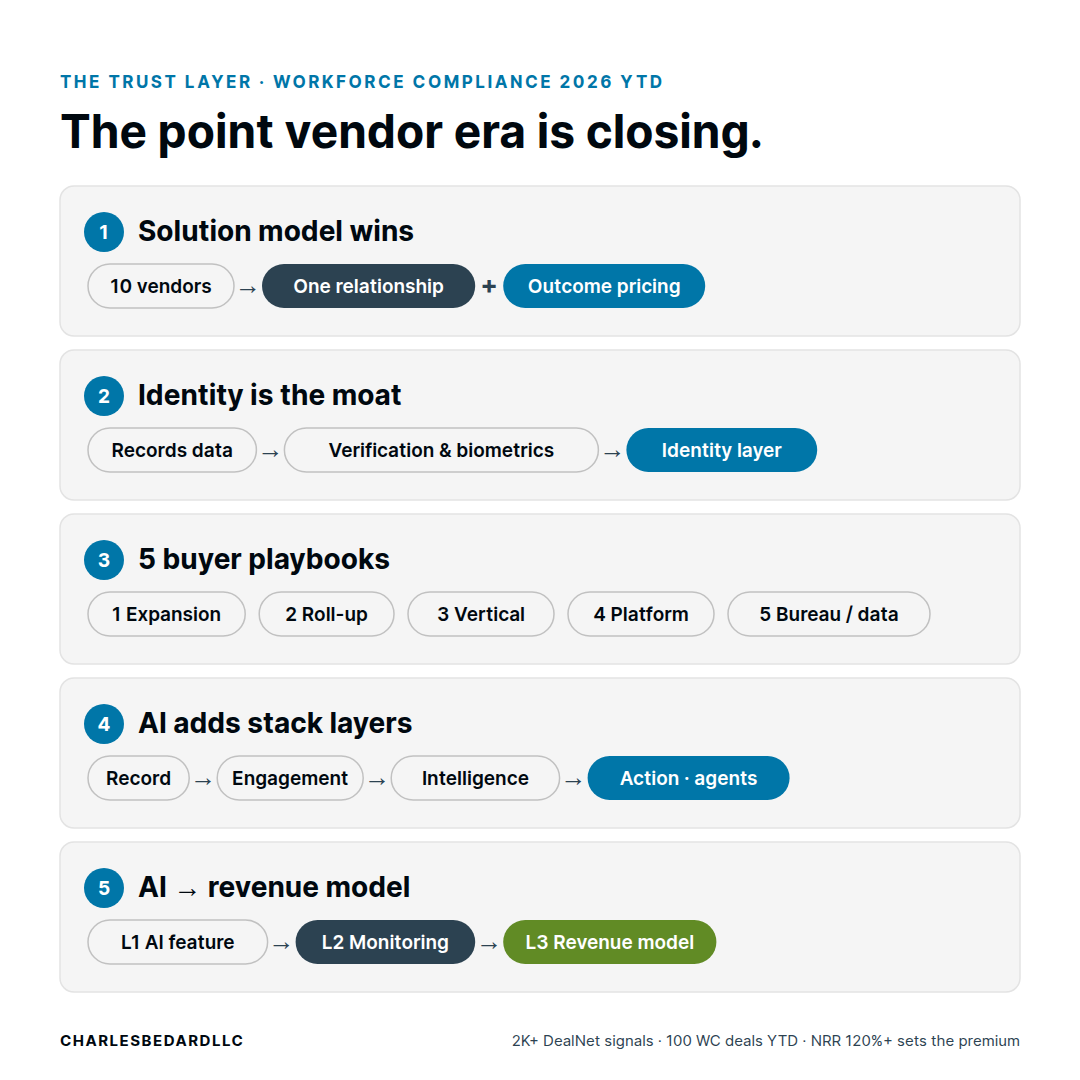
The short answer: strategics are building solutions.
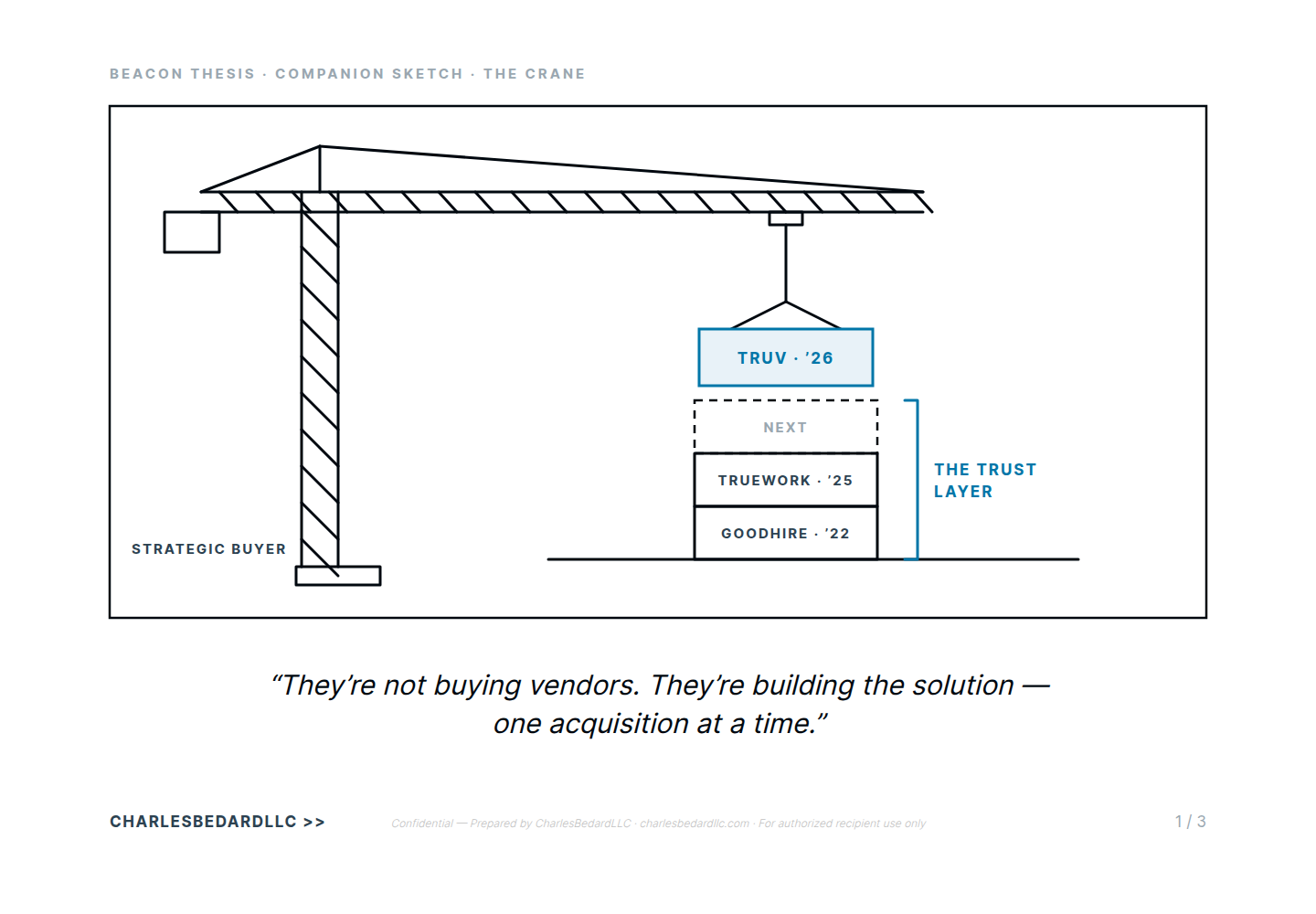
DEALNET signals monitoring insights YTD finding: Nine months into 2026, DealNet has logged 2K+ market signals across B2B Work Tech — including 100 deals across the broad Workforce Compliance category (background screening, employment identity verification, safety and regulatory compliance, pre0hire and post-hire compliance). After review, they show an industry reorganizing around one idea: strategics are building solutions.
A beacon doesn't steer the ship — it marks the safe channel every ship must pass. In the AI era, identity and compliance are becoming that beacon: the Trust Layer every hire, payment and agent has to clear.
FIVE FINDINGS AT A GLANCE
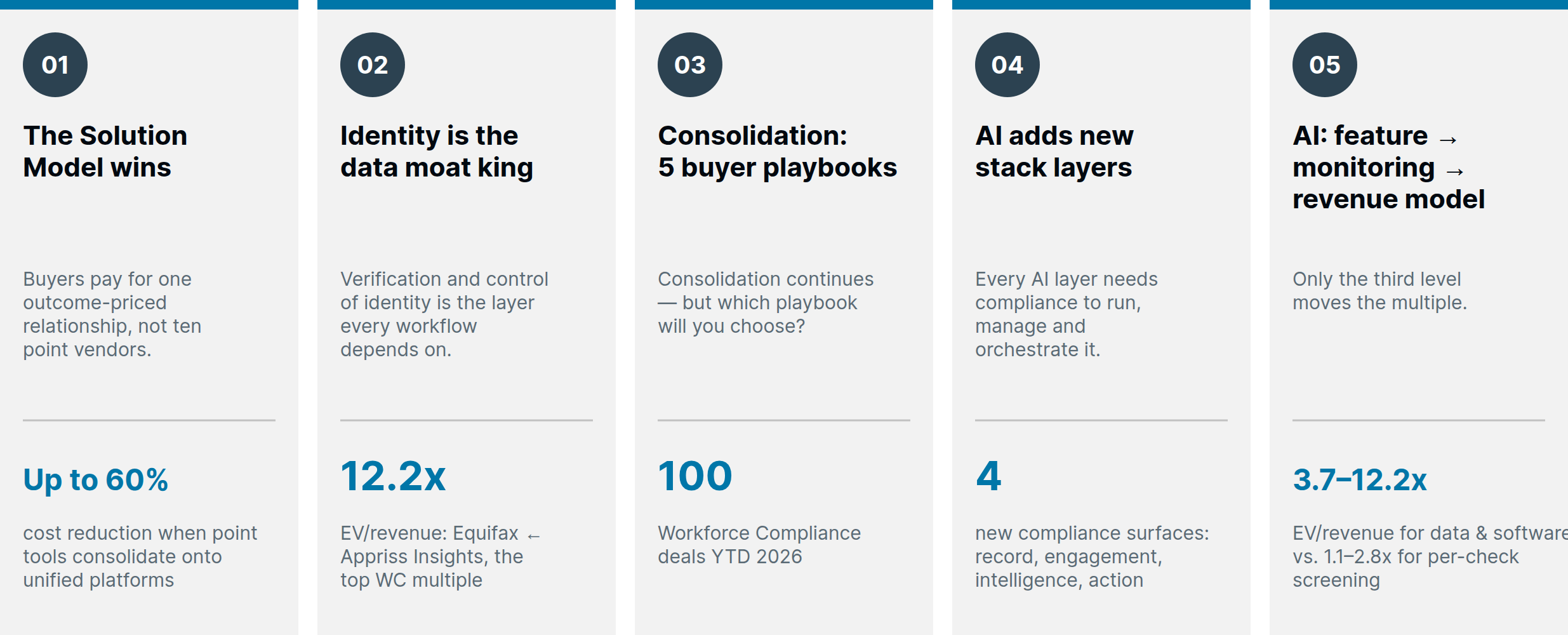
Finding 1 — Why is the Solution Model winning?
Because buyers now pay for one outcome, not six to ten vendors. Every platform wants to be the one place a client trusts to stay compliant.
• Equifax acquired Vault Verify (Jan) — adds automated employment verification.
• Veriff acquired Vespia (Feb) — adds business identity verification (KYB).
• Experian acquired Konfir (Apr) — adds employment and income verification.
• NEOGOV acquired Miller Mendel (Apr) — adds background-investigation software.
• Amadeus acquired IDEMIA Public Security (Apr, $1.4B) — adds biometrics identity.
• Gusto acquired Mosey (Apr) — adds multi-state registration and compliance.
• Lumber acquired Pivla (May) — adds construction wage compliance.
• TreeRing acquired PrimeTime (May) — adds workforce time-tracking compliance.
• 360training acquired the National OSHA Foundation (Aug) — safety compliance training.
• Sheakley acquired HRlogics (Aug) — adds unemployment cost management and verification.
• Checkr agreed to acquire Truv (Aug) — adds a consumer-permissioned verification network.
• DISA acquired TEAM Companies (Sept) — adds screening and compliance services.
• Bchex acquired LS Screening (Aug) — adds background screening.
• A&M Capital Partners acquired Contemporary Information (Mar) — adds criminal records data.
• BV Investment Partners invested in Thomas & Company (Aug) — a workforce compliance platform (PE investment).
• Dozens more acquisitions last year as well…
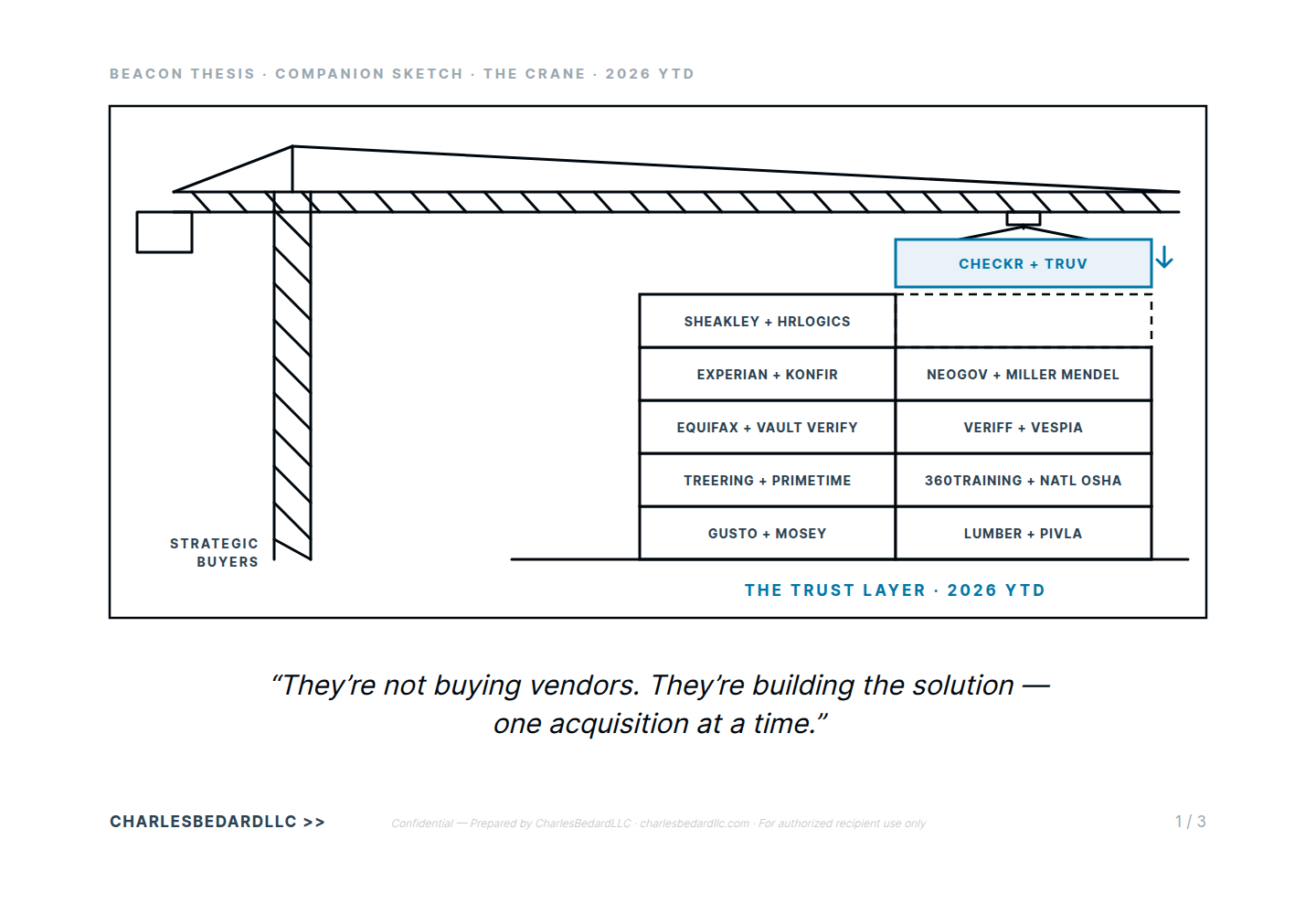
My analyst take: The Solution Model replaces a number of ## contracts, ## SLAs and ## invoices with one relationship priced on outcomes. Point vendors that stay point vendors become someone else's feature delivered via an embedded platform behind the scenes.
The bottom line: Point vendors still win on niche vertical specialization features. But organizations and companies that consolidate onto unified platforms report up to 60% cost reductions — by cutting redundant tools, eliminating rework, data maintenance, and complex compliance auditing[1].
Finding 2 — Why is identity the data moat king?
Because verification and control of identity is the one layer every other workflow depends on. The largest buyers this year are bureaus and identity networks, not screening firms.
The five named deals above, plus dozens more from the recent years shows the identity value.
Why it matters (the logic)
Everything starts with who the person is. Screening, I-9/E-Verify, payroll, benefits, tax credits and monitoring all begin by confirming the person is who they say they are. AI agents now have to pass that check too before they can act. Whoever owns that confirmation connects all the other steps.
The data builds on itself and is hard to copy. Equifax's The Work Number, bought with TALX in 2007, holds employment and payroll records that employers keep sending in. Every new verification makes the database more valuable. A newcomer can copy a software feature, but not years of verified records.
It gets paid for again and again. A worker is verified at hire, checked again through monitoring, and verified again by lenders and government agencies. The same record earns money over and over, while a point vendor gets paid once per check.
AI raises the stakes. Fake identities and deepfakes make verification harder. Agents doing work also need a trusted identity to act under and to be audited against. So identity becomes the control point for the whole system, not just one step in it.
The proof
Valuation: among Workforce Compliance deals, data and identity assets went for 3.7–12.2x revenue[1], while per-check screening went for 1.0–2.8x.
Where buyers are spending in 2026:
Equifax acquired Vault Verify.
Experian acquired Konfir.
Amadeus acquired IDEMIA Public Security for $1.4B.
Checkr is assembling a verification network: Truework, then Truv.
What it means for a founder: if you own the identity or verification record, you're the layer others build on. If you don't, you're a feature sitting on someone else's layer, and you'll be valued like one. Either own a piece of the identity data or partner deeply with whoever does.
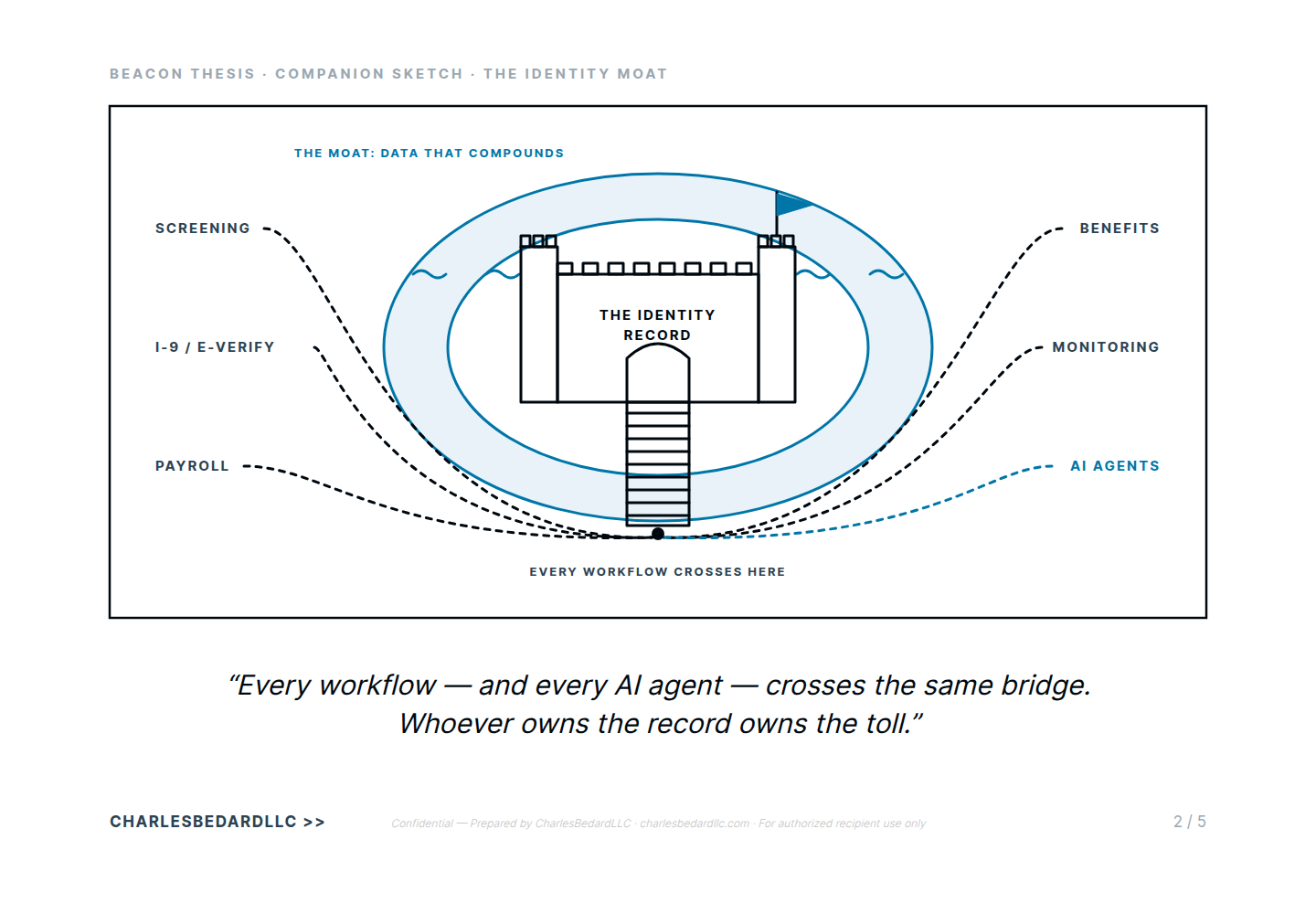
My analyst take: Identity is the beacon the rest of the workflow steers by. Whoever controls verified identity controls the re-check, the monitoring and the next product. The per-check CRA gets squeezed from above; the owner of the identity record keeps the premium.
Finding 3 — Consolidation continues — but which of five playbooks will you choose?
There are many more types of M&A than a “merger” or an “acquisition.” Here are five (5) prevalent corporate development playbooks, each paying for something different, each with its own strategy.
1. Product Expansion — buys data and verification feeds adds product (Equifax, Experian).
2. Roll-up — buys screening and compliance scale (DISA → TEAM Companies; Bchex → LS Screening;
3. Platform + addon PE (private equity) playbook NEOGOV, backed by EQT and CPPIB → Miller Mendel; BV Investment Partners → Thomas & Company, August, Cisive (GTCR) acquired DriverIQ, Intellicorp, PreCheck.
4. Platform consolidation — buys compliance as a feature to add revenues increase value per customer, and prevent churn (Gusto → Mosey; TreeRing → PrimeTime).
5. Vertical SaaS — buys and builds the most valuable industry bundle (Lumber → Pivla; for construction, Cisive for highly regulated, Momentive Software formally Community Brands and Ministry Brands for nonprofit, NeoGov for government public sector).
Analyst take: More than 100 background-screening providers have been acquired since 2020 — and 100 deals have closed across the broader Workforce Compliance category this year alone. The buying has reached the $1M–$50M founder-owned tier. The question is no longer whether to plan for a buyer — it's which playbook fits your model, because each one values you differently.
Finding 4 — Where has AI created new compliance work?
AI has added new layers to the tech stack — and every layer needs compliance to run, manage and orchestrate it. Records, engagement, intelligence and now agents that take action each carry their own data, model and governance obligations.
• Phenom's Voice Screening Agent won a 2026 CODiE award — AI agents now sit inside the hiring workflow, and so do the rules that govern them.
• Payscale and Trusaic built EU pay-transparency datasets and partnerships ahead of the directive.
• Accurate Background added a Chief Legal Officer (February) and a Senior Director of AI (June) — compliance and AI leadership built side by side.
• Warp raised a $60M Series B (Battery Ventures) to automate payroll compliance, and
• Achieve Partners closed a $450M Workforce Fund II aimed at AI-driven labor disruption.
My analyst take: Every new AI layer is a new compliance surface. The firms that can govern the whole stack — not just one check in it — become the orchestration layer.
Finding 5 — How has AI moved from feature to revenue model?
AI in Workforce Compliance matures in three levels — and only the third moves the multiple.
1. AI as a feature — assistants and agents that speed up the work (HCM TradeSeal's TeamMate AI assistant for certified-payroll compliance; Phenom's voice screening agent).
2. AI as intelligence and monitoring — continuous, always-on oversight instead of a one-time check (Accurate Background's AccurateWatch, launched April).
3. AI as the revenue model — priced on outcomes and usage, expanding within the base (compliance and tax-credit platforms pricing against outcomes rather than per-check fees; bundled verify-comply-onboard suites).
My analyst take: A feature cuts cost. Monitoring turns a transaction into a subscription. An AI revenue model turns the subscription into expansion — and NRR above 120% is where the premium multiple starts.
Finding 6 (emerging early-stage) — Why is retention analytics finally solvable?
Because three things now line up for the first time: digital wallets, the identity Trust Layer and AI-era analytics. Draft — to be developed.
• Digital wallets: verified credentials now travel with the worker (phone wallets and portable credentials), so the same identity follows a person from hire to rehire to the next employer.
• The Trust Layer: a governed identity and consent layer links the pre-hire check, the post-hire record and the exit, instead of leaving each one in a separate vendor's silo.
• AI-era analytics: with a persistent, verified identity, cohort retention, tenure and churn signals can be measured and predicted across the whole worker lifecycle — not rebuilt from disconnected files.
My analyst take (working): Retention has always been the metric that sets the multiple, and the one Workforce Compliance firms could least prove. When identity persists and consent is governed, retention stops being a guess — for the employer and for the compliance provider's own NRR. Evidence, examples and data to be added.
Exhibit — Where the Trust Layer started: our 2025 New Year update
Headline: "The provider market is converging between pre-hire talent acquisition and post-hire workforce compliance." Employers are moving from fragmented point vendr era solutions to bundled, embedded, AI-enabled platforms because a solution is what the customer prefers. “Integrated compliance partner ecosystems” were in vogue in 2010. Today, the solution earns premium pricing, defensible distribution and durable growth.
1. Pre/post-hire convergence: post-hire leaders (Mitratech, Vensure, Selerix) are adding pre-hire capabilities, while emerging growth firms build integrated full-suite solutions.
2. Platformization and industry consolidation: PE platforms consolidate, and point solutions (background screening, assessment and testing, eRecruiting and onboarding) roll up into unified platforms.
3. Everything-as-a-Solution: agentic AI and intelligent automation become "the new minimum professional standard for digital transformation."
The convergence story. Workforce Compliance was long "an island of misfits," sitting apart from HR, payroll, finance and IT platforms. That separation is eroding: more than 150 of the top 500 workforce compliance providers have merged or consolidated since COVID. Pre-hire (sourcing, assessment, screening, verification, credentialing, onboarding) and post-hire (finance, tax and payroll compliance, benefits and comp, training, offboarding) are converging into a single as-a-solution lifecycle offering.
Why it matters economically. Convergence lets a provider capture both the ARR subscription wallet and the highly profitable transaction spend. Post-hire compliance is the bigger, more profitable opportunity — roughly 2x the size of the pre-hire TAM and still an early-stage blue ocean. Buyers spend roughly 4–5x more per employee on compliance transactions than on SaaS subscriptions.
Two deal-strategy plays.
• WC channel strategy (non-direct): win SMB and mid-market clients indirectly by embedding compliance — screening, I-9 / E-Verify, WOTC tax credits — into payroll, PEO, HCM and workforce platforms through revenue-share partner programs.
• Regulated-niche strategy, premium bundles (>$2K per transaction): sell high-value, multi-module compliance bundles directly into regulated verticals — healthcare, DOT, finance, education and government contractors.
My analyst take: The 2025 call was convergence; the 2026 deal flow proves it — and adds the layer that makes it work. Convergence needs a trusted identity and governance layer underneath it. That is the Trust Layer.
Exhibit — 2025 market themes and narrative drivers
Eight themes ran through our 2025 Workforce Compliance coverage — and each one set up the 2026 findings that follow.
1. Consolidation is the dominant narrative. Industry consolidators (paying ~1x to 2x revenue) and PE-backed platforms (paying ~5.4x to 8x EBITDA for private/bootstrapped ) are absorbing small private CRAs and pre-hire software and compliance vendors. 200+ deals since 2020 in North America.
2. Verticalization. Expansion into regulated and niche verticals — healthcare, government / GovCon, transportation, long-term care, nonprofits, e-commerce, gig and last-mile — is framed as both a defensive and a growth strategy for operators and their acquirers.
3. Product expansion and platformization. Bundling pre-hire (screening, ID, credentialing) with post-hire (ACA / 1099, continuous monitoring, benefits) compliance adds share of wallet, with a claimed ~30% incremental revenue uplift per existing customer dollar from cross-sell.
4. Continuous monitoring. Ongoing monitoring is emerging as a service line that displaces one-time snapshot checks (Yardstik and mybinc.com cited as product examples).
5. Compliance-as-a-Service. "Compliance-as-a-Service," "Everything-as-a-Service" and BPaaS are the recurring vocabulary for the shift from labor-centric transactional delivery to tech-centric subscription and managed models.
6. AI and automation as the wedge. AI-native automation — WOTC discovery, document AI, fraud and error detection — is displacing manual compliance processing. Cited AI-native players: KarmaCheck, Canary AI, Certn, Checkr, Harmonize.io, Prembly. More than 75% of deal dollars over the past two years went to AI.
My analyst briefing in five questions
• Why is the Solution Model winning? Buyers pay for one outcome-priced relationship, not six point vendors.
• What is the data moat? Identity — verification and control of the record every workflow depends on.
• Is consolidation one market? No — five buyer playbooks, each valuing you differently.
• What did AI add? New stack layers, each needing compliance to run, manage and orchestrate.
• Where does AI move the multiple? At level 3 — AI as the revenue model, with NRR above 120%.