
The Backoffice Is Converging — and the Premium Goes to Whoever Owns the Controls
· BACKOFFICE CONVERGENCE DEALTALK
What this year’s deal flow says about the market, the industry winners, and what the market pays for — and what it means for owners, operators and sponsors across the backoffice technology and services.
In the past, the various functions of the backoffice were sold in pieces. CPA was a vendor. IT was a vendor. Payroll was one vendor. HR was another. Dozens of vendors, hundreds of apps. Sometimes more.
Spend, Revenues, Tax, Administration, Planning each had their own vendor. That structure was broken; but is now rapidly changing in real time — and the deal flow of 2026 shows it more clearly than any product roadmap. The way we buy and sell products and services is changing while we are driving down the road.
My read after tracking this year’s transactions is simple: the backoffice is converging, and the premium values is moving to whoever owns and controls the movement of the data.
Follow the data, not the category
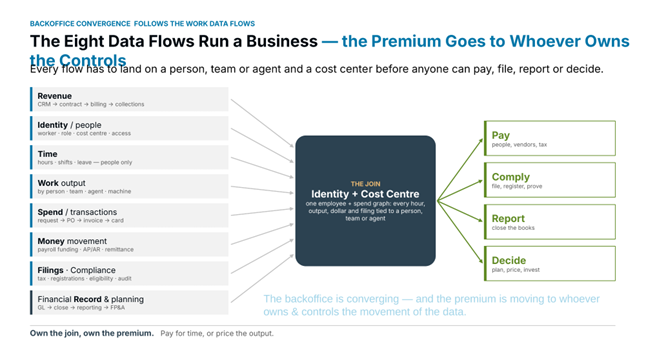
Every business runs on eight data flows: revenue, identity, time, work output, spend, money movement, filings for compliance, and the financial record. Each one has to land on a person, team or agent — and a cost center — before anyone can pay, file, report or decide.
That landing point is the control command center: identity plus cost center. Whoever owns the control owns the customer relationship, because every other flow has to pass through it. Two points worth underlining. Time is a people-only flow — hours, shifts, leave. Work output is not: it can come from a person, a team, an AI agent or a machine. That split is where seat-based pricing gives way to outcome-based pricing.
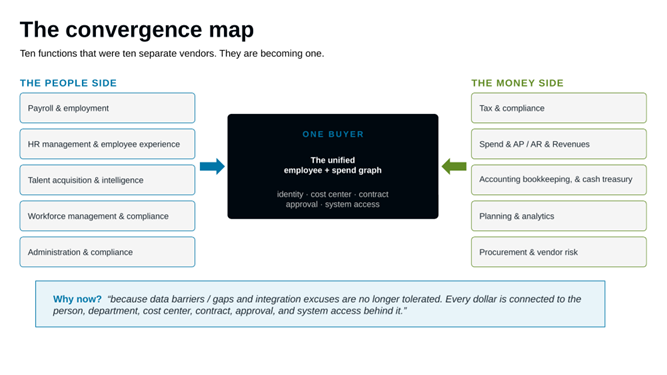
Map those flows onto the functions and you get ten categories that used to be ten separate functions — five on the people side, five on the money side — collapsing toward one.
And the unified employee and spend graph is of the great starting benefits enabling true AI era revenue quality for job costing and planning – meeting at the intersection of RevOps X FinOps X PeopleOps supporting by the technology and AI agentic era.
Why now
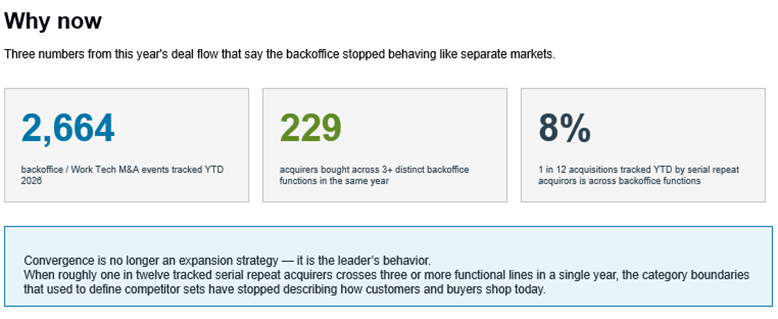
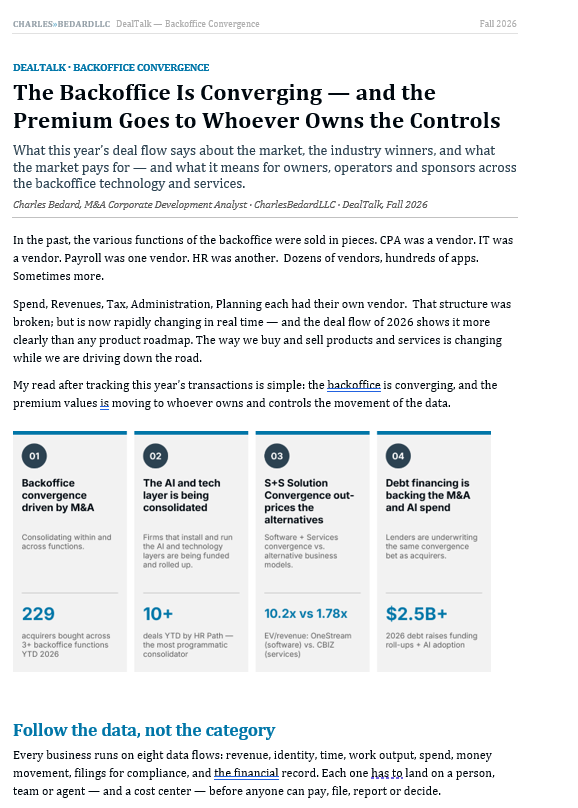
Three numbers from this year’s DealNet tracking say the backoffice stopped behaving like separate markets: 2,664 backoffice and Work Tech M&A events tracked year to date; 229 acquirers that bought across three or more distinct backoffice functions in the same year.
When roughly one in twelve tracked serial repeat acquirers crosses three or more functional lines in a single year, convergence is no longer a direction of travel. It is the median behavior.
The unit economics: why the customer is voting for convergence
The demand side matters as much as the capital side. Start with where a dollar of revenue goes. For a typical company, labor and benefits run about 25¢ of every dollar (a published range of 7–30¢), while technology runs about 5¢ (2–20¢). Labor costs four times what technology does.
That is the line AI and convergence go after — not the software budget, the labor budget.
Now look at it through the CXO’s eyes. In the recent past, a company had 25+ vendors and 200+ apps, reconciled by hand and priced on seats and hours.
Versus the converged model that runs one to three vendors and one to three logins, with agents reconciling and people handling the exceptions.
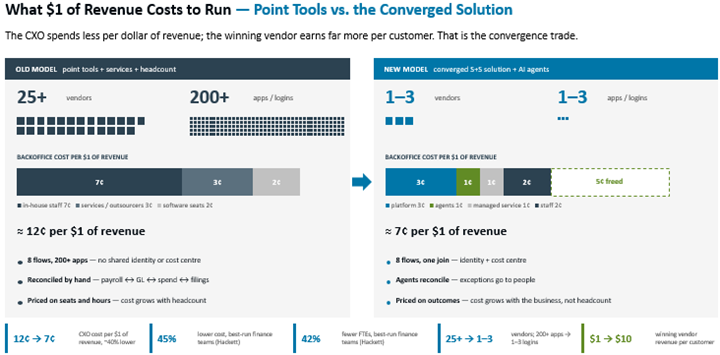
In my illustrative model, backoffice cost falls 30% to 55% from about 12¢ to 7¢ per dollar of revenue — directionally consistent with analyst finding that the best-run finance teams operate at 45% lower cost with up to 42% fewer FTEs. The customer spends less per dollar of revenue; the winning vendor earns far more per customer. That is the convergence trade.
The pattern
Three things this year’s deal flow of M&A and investment says that last year’s did not. Convergence runs both ways. The services layer is being bought, not disintermediated. And the premium sits on compliance and money movement — the functions that carry regulatory obligation and touch the money re-rate; the functions that carry labor effort do not.
Case studies: five ways to win the convergence
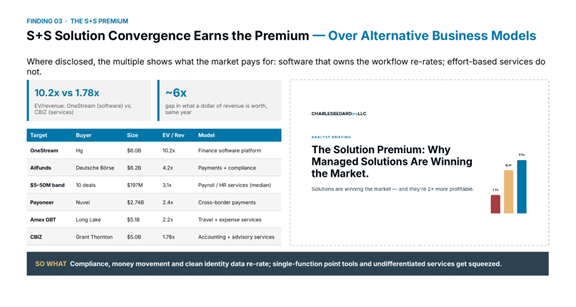
S+S Solution Convergence earns the premium over alternative business models
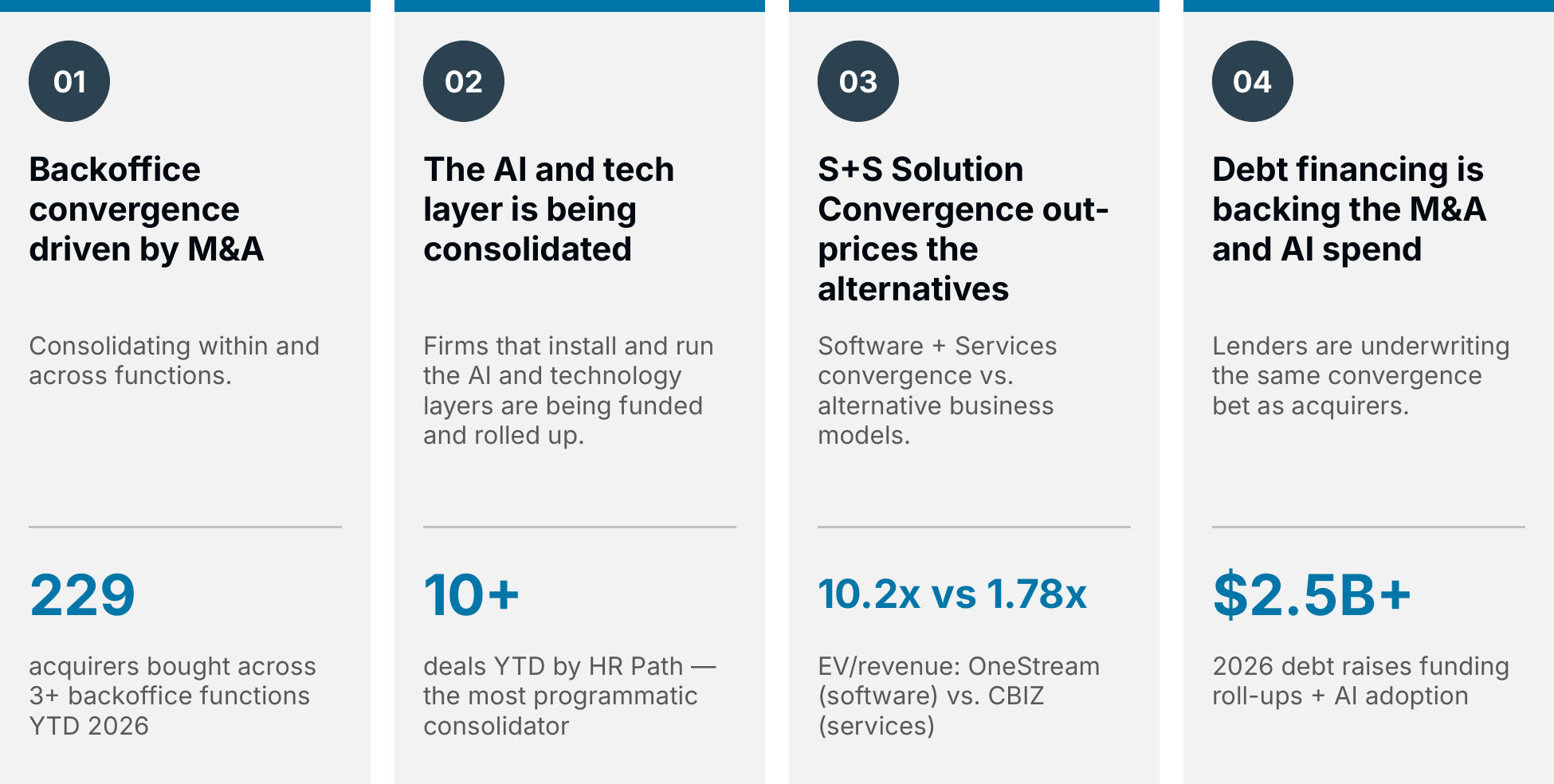
Where terms are disclosed, the multiple tells you which side of the convergence the market is paying for. Software that owns the finance workflow printed 10.2x revenue (Hg / OneStream). Services that deliver a similar outcome printed 1.78x (Grant Thornton / CBIZ). Same convergence, same year — roughly a six-fold difference in what a dollar of revenue is worth, and the gap is not explained by growth alone.
This quarter's analyst coverage:
Playbook — The 5 Winning M&A Playbooks for Corporate Development Buy-and-Build Strategies July 2026
Briefing — The Solution Premium Playbook: Why Software + Services Is Converging Now, and The Correction Is Already Priced In Sep 2026
Catalog — Fall eNewsletter Catalog Preview of my Analyst Quarterly Coverage: The Winning Playbook for the AI Era Corporate Development Sep 2026
Market Map Rankings — The Catalog of Market Map Rankings Across 50 Product Categories for Work Tech, Backoffice to Frontoffice Oct 2026
Full coverage archive and ongoing analysis:
LinkedIn Newsletter
