The Solution Premium Playbook: Why Software + Services Is Converging Now
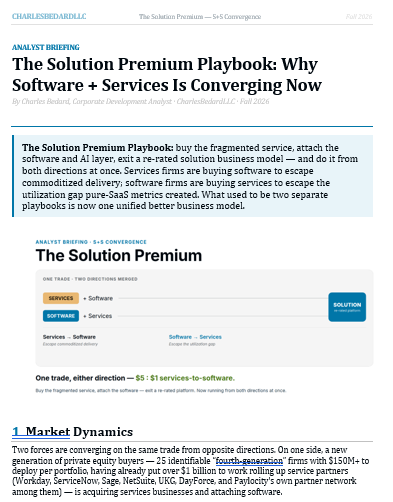
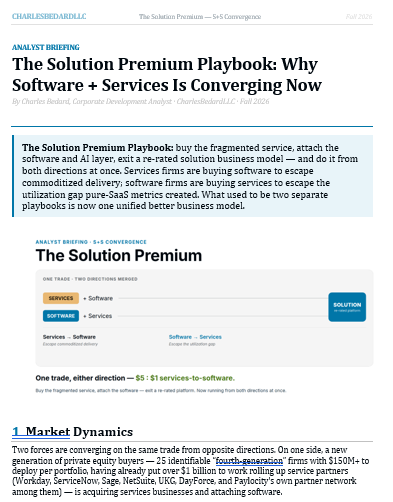
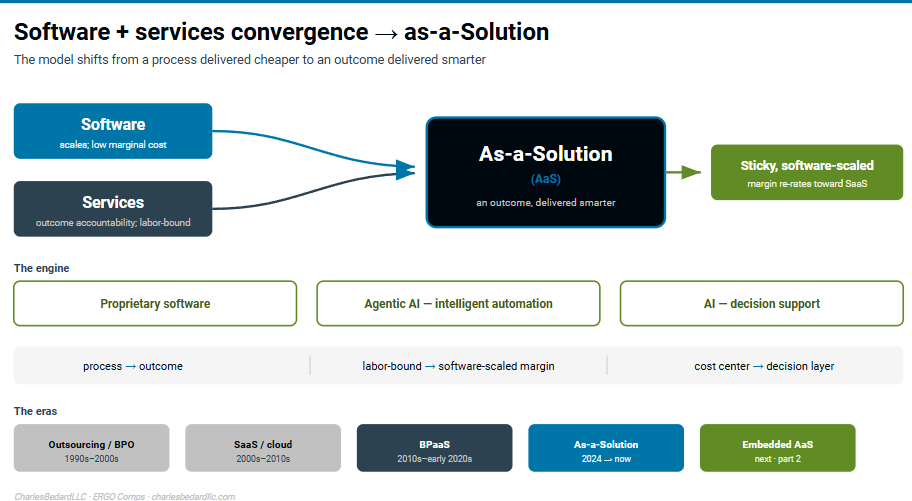
The Solution Premium Playbook: buy the fragmented service, attach the software and AI layer, exit a re-rated solution business model — and do it from both directions at once. Services firms are buying software to escape commoditized delivery; software firms are buying services to escape the utilization gap pure-SaaS metrics created. What used to be two separate playbooks is now one unified better business model.
1 Market Dynamics
Two forces are converging on the same trade from opposite directions. On one side, a new generation of private equity buyers — 25 identifiable “fourth-generation” firms with $150M+ to deploy per portfolio, having already put over $1 billion to work rolling up service partners (Workday, ServiceNow, Sage, NetSuite, UKG, DayForce, and Paylocity's own partner network among them) — is acquiring services businesses and attaching software.
On the other, software companies that spent the last cycle chasing pure-SaaS metrics are buying back the services layer they stripped out, pivoting from vertical-SaaS positioning toward mission-critical or solutions-oriented offerings.
The convergence is not a prediction. It is already showing up in gross margins: companies that reintroduce a services layer are moving from roughly 50% back up toward 75%, closing a utilization gap that venture capital's insistence on pure-software metrics created in the first place.
It is showing up in deal count and deal size across DealNet's own tracked activity. And it is showing up in where the capital is actually going — not toward the largest, most-covered names, but into the underserved middle market between “Main Street” and “Wall Street” that most public analysis skips entirely.
2 Deal Drivers: News Highlights YTD Stats
The signal, in numbers

Timing: where we are in the cycle maturity curve
Technology cycles of this kind have historically run about 18 years; on that clock, the market is roughly in year four, with four more years of intense investment still ahead. The economics are reverting to a client-server-era ratio — with $5 spent/allocated for services for every $1 of software — which is worth pausing on: by shifting from a pure labor services model or software there is another $5 in revenue per customer[1]. Two separately derived figures landing on the same ratio is a stronger signal than either one alone.
The valuation reset already underway. Companies that raised at 2021–22 vintage valuations are, in large part, unrecoverable at those marks — Bending Spoons holdco acquisition, previously acquired Evernote, WeTransfer, Vimeo, Eventbrite, of AirTable (SaaS no-code/low0code platform) for $1.29 billion enterprise value was a massive haircut to is peal $11.7 billion valuation December 2021 after its $735 million Series F funding round, Thoma Bravo walked away from Medallia (CX SaaS) in June 2026 a $5 billion loss, Headspace's (SaaS wellness platform serving 2k corporate clients + D2C B2C) fall from a $2B valuation to a $200–300M exit is the cited preview of a broader pattern.
By my estimates, 10% of small private businesses will exit the US market outright rather than adopt an AI solution model. Old vintage early-stage companies more broadly are facing write-downs to 30–90% of current valuations. For corporate development executives, that reset is the opportunity: quality assets are coming to market at prices the 2021 environment would never have allowed.
[1] The $5:$1 varies by industry vertical, market size, company maturity; there is ample evidence of $4:1 during client-server era for implementation, then managed services, plus maintenance services as well as digital transformation projects
3 Market Drivers
These Deal Drivers (new AI era business cycle, and change in SaaS pricing) explain why the capital is moving. Market Drivers explain why the customer is buying — the demand-side case for why a business leader, an IT buyer, or a CFO increasingly picks a “solution” over either a standalone software seat or a standalone services engagement.
Five (5) factors show up repeatedly across the customer’s decision making process with the primary driver being ROI /TCO driven by usage our outcomes versus paying for licenses / seats.
1. ROI / TCO: Return on investment and total cost of ownership, &/or actual usage of what was purchased, satisfaction with the outcome delivered, speed to realized value, and the number of vendors a customer can consolidate down to.
Underneath the ROI/TCO driver sits a structural driver: the software utilization crisis. Most SaaS software was built for customers to use based on their horizontal function; with specific modules designed per functional user, versus software designed for the end users and managers who actually produce the volume of work output every day — Workday is the frequently-cited example, extensive in capability and thin in employee contributor usage adoption.
That mismatch has created the opening services are now filling, and it is also why the fix increasingly looks like an interface problem rather than a features problem: AI agent layers that meet users conversationally are being pitched as the practical way to recover utilization without a re-platforming project. The operative discipline has shifted from “spend on AI” to “prove ROI from AI” — most organizations are still in early automation phases, single-digit percentages of work actually automated, and the value that does exist is coming from context capture and knowledge-base building rather than outright role replacement.
That utilization crisis is also reshaping the org chart itself. Traditional backoffice roles – payroll, bookkeeping, administration, and HR/benefits roles are being restructured as rigid functional silos break down.
The stack of layers has expanded: Infrastructure (IaaS), Hardware & PaaS, Software & SaaS, Governance and Access, DaaS (data and memory), an AI layer (LLMs, NLPs), Agentic Layer, Orchestration Layer, a Context layer on top (the brain), and UI/UX.
4 Industry Competition Stories
The public acquirer race
Among the platforms large enough to disclose activity, the pace is busy — and instructive about who is playing offense. ServiceNow, Workday, ADP all 10+ deals.
Across industry snapshot: Deel, HR Path SAS, Mitratech Holdings, The Access Group, Vensure HR leads People & Talent M&A since 2020 with double-digit acquisitions — vertical leaders HealthStream & IdeaGen, and SalesForce for CRM/Frontoffice, and Accenture leads Software & Services with 21+ deals.
The quieter consolidation
Away from the public and notable industry investor backed leaders names, the more consequential activity may be the sponsor-led consolidation running underneath the headlines. Serial roll-up sponsors to name a few with double-digit deals since 2020 — Accel-KKR, Alpine Investors, Banyan Software, Exa Capital, Main Capital, PSG, Valsoft, Visma, , and the Constellation entities like Volaris Group among them — are already active in solutions and largely under-covered by mainstream “Wall Street” deal press. And behind both of those sits the larger, less visible wave already described in Market Drivers: fourth-generation PE firms with $150M+ to deploy per platform, quietly rolling up service partners at over $1 billion in aggregate deployment TTM. This is the volume version of the same trade the marquee deals get credit for in the newspapers.
5 AI Revenue Cases
AI as a revenue line
The forward-looking evidence is solution vendors turning AI itself into a distinct, disclosed line of revenue rather than a bundled feature.
- Rippling's AI launch[1] with AI token management and cost optimization is now its fastest-growing revenue stream — a second-generation platform move, selling into AI/governance budget rather than the traditional HR buyer.
- Paylocity's push into spend management + FP&A[2] is credible, AI-adjacent path to capturing customer share of wallet across functions from the office of the CFO to IT to HR and backoffice administration and compliance, versus competing primarily on HCM feature parity alone.
Useful as market context, many uses cases are emerging showing strong proof that AI is converting to realized revenue rather than announced strategy.
6 Storybook — Five Winning M&A Playbooks
The convergence isn't one playbook — it's five, each already proven by a named operator. Sourced from this firm's own “5 Winning M&A Playbooks” DealTalk (June 2026).
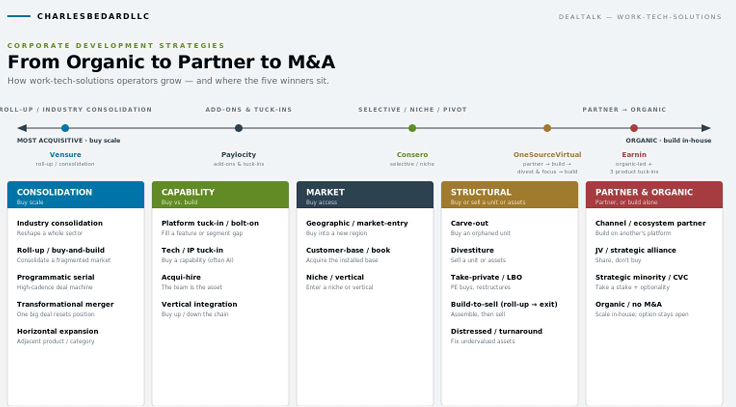
Three repricings are happening at once — pure-SaaS multiples down, unprepared owners getting caught with nothing of value, and services-plus-software turned solutions multiples up to all-time high. None of this is speculative: every figure below is already in the deal data.