
Ahead of HR Tech 2026: Where the Capital Is, and What the Agenda Covers
Investors already back between 32% and 73% of the firms in each of the ten HR tech categories where we have measured ownership. HR Tech opens in Las Vegas on October 20, and its agenda puts AI at the center. Here is what our research shows, our take on the agenda, and the HR tech categories we cover.
Our finding: Investors are in every HR tech category we measured, but most heavily in the AI-driven ones.
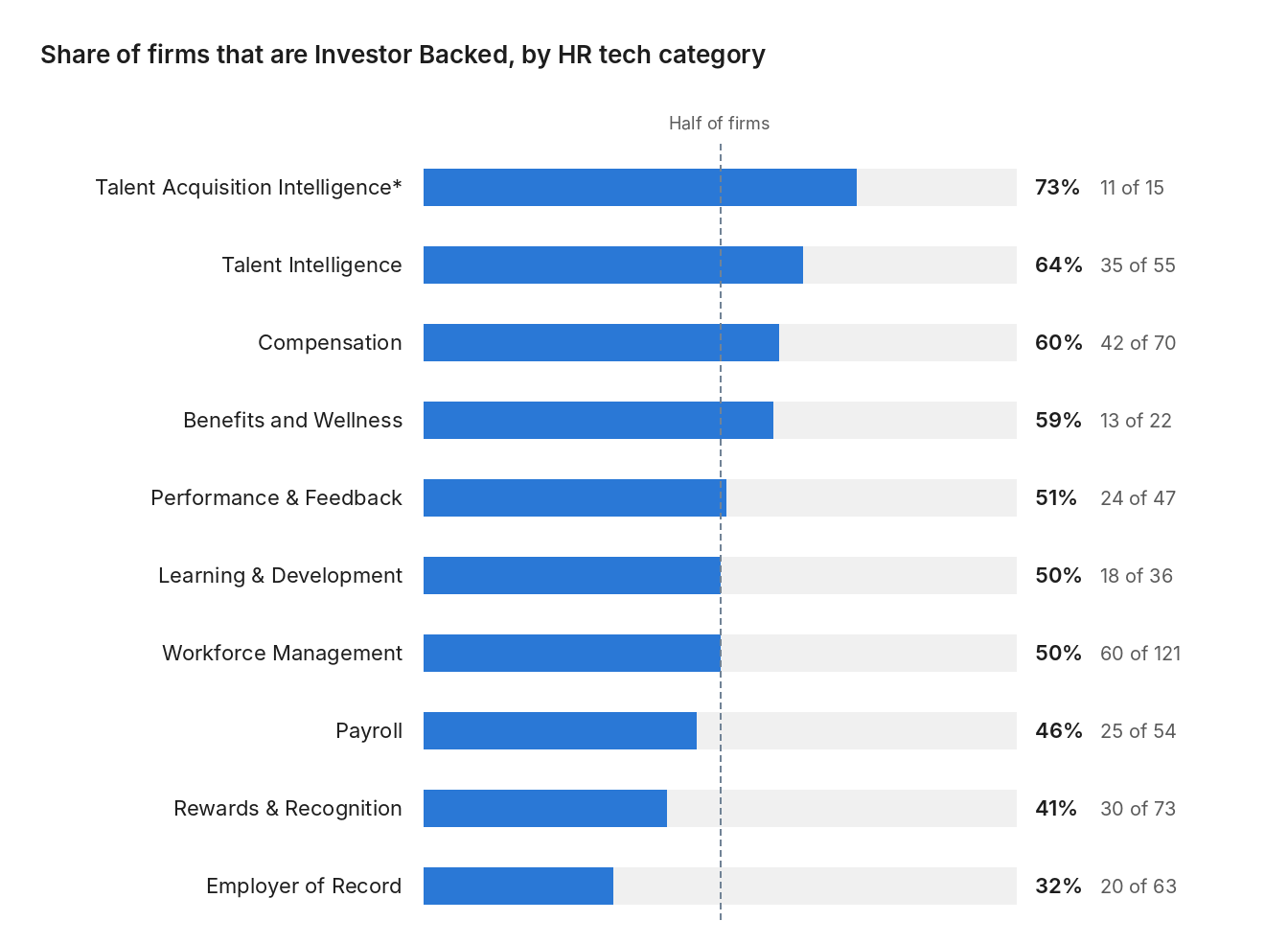
Source: DealNet: our market maps and company data, 2023–2026, of Private and Investor Backed* firms with $5M+ operating in the US.
The two categories at the top, Talent Acquisition Intelligence and Talent Intelligence, both use AI to turn people data into hiring and talent decisions. Rewards & Recognition, near the bottom at 41%, is a much older category: its firms average 23 years old, against 14 years for Talent Intelligence (ages across all ownership types).
Our read: investors are backing these categories because AI made people data usable. It used to take too long to clean and connect; now it can support decisions in near real time. In hiring, that shows up as speed: Chipotle cut the time from application to start from 12 days to 4 using Paradox. Large platforms are buying in too: Workday acquired Paradox for $1 billion in 2025. Compensation is the exception: an established category that is still 60% Investor Backed.
The HR Tech Conference itself treats investors as one of its four core audiences and runs a dedicated investor track, a sign of how much capital now shapes this market.
This is why we track ownership alongside revenue. Who owns a company shapes what it can do next: raise, buy, or sell.
What sits behind these numbers
We map the HR tech market in the categories below.
Benefits and Wellness: benefits administration, benefits software, and wellness
Compensation: setting fair and competitive pay
Employee Experience: culture, engagement, and wellbeing
Employer of Record: legally employing staff on a company's behalf, often in other countries
Learning & Development: building employee skills
Payroll: paying employees accurately and on time, including taxes and deductions
Performance & Feedback: goals, reviews, and feedback
Rewards & Recognition: recognizing and rewarding employees' work
Talent Intelligence: using data and AI to make people decisions, including talent acquisition intelligence (TAI), the hiring side of talent intelligence
Work Tech: administration and compliance, productivity, and intelligence
Workforce Management: scheduling shifts, tracking time and attendance and managing labor costs
Vendors are already buying each other
The HR Tech agenda covers buyers reducing the number of vendors they use. Our deal tracking shows the other side: vendors acquiring other vendors. We track more than 100 buyers in this sector that have each made more than one acquisition since 2020.
*What "Investor Backed" means: Companies that have received funding from investors, such as venture capital firms, but are not classified as private equity-owned, company-owned, or publicly traded.
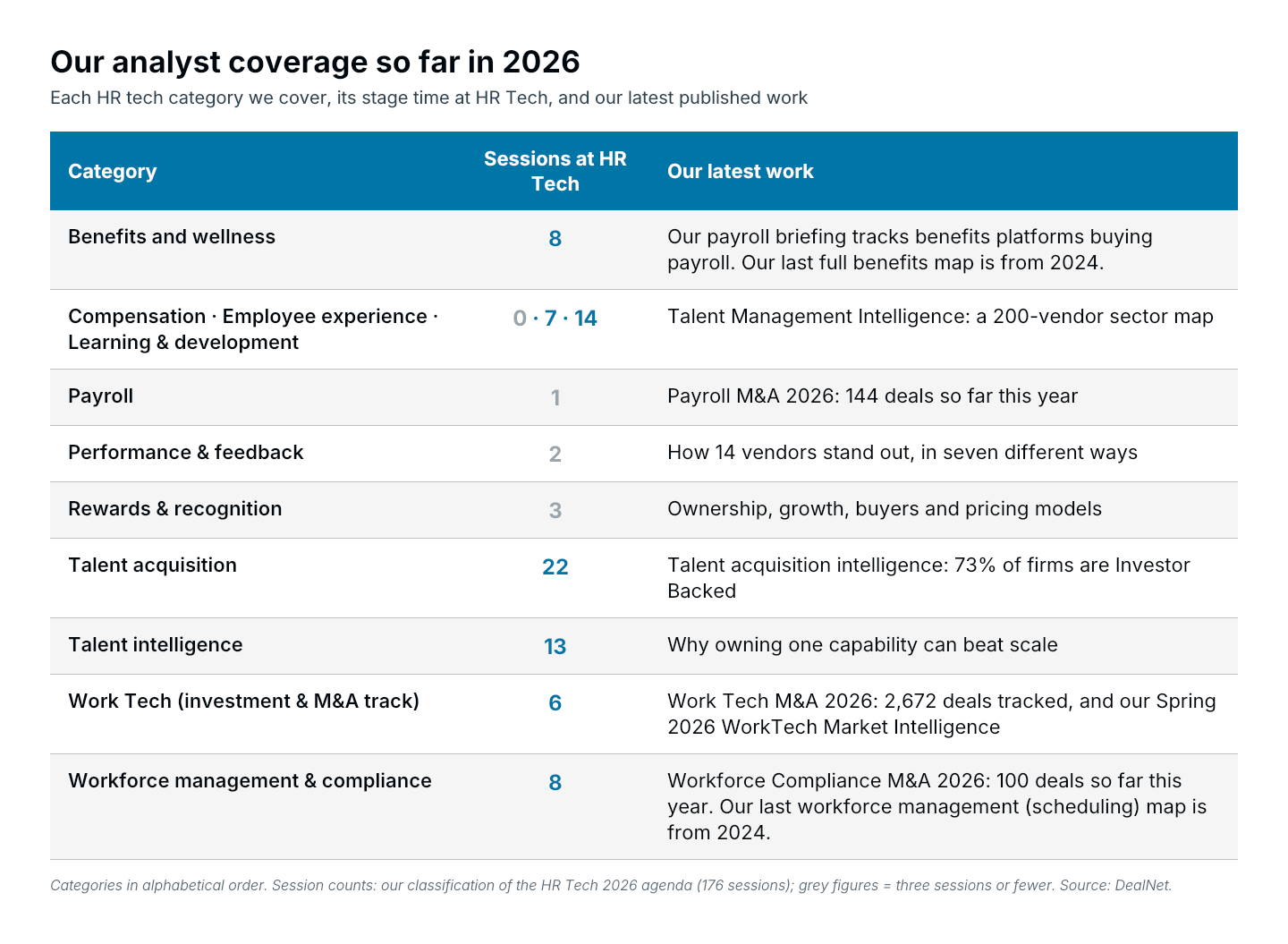
Our analyst coverage so far in 2026
Our published work on each HR tech category we cover, and how much stage time each gets at HR Tech.
Our take on the 2026 agenda
HR Tech runs October 20–22, 2026, at Mandalay Bay in Las Vegas. The site describes four groups of participants: HR leaders, exhibitors, industry analysts, and investors. It lists 7,200+ HR and business leaders, 400+ solution providers, 275+ speakers, and 200+ sessions. The home page leads with the headline "From Change to Transformation" and calls AI the largest workforce disruption in a generation.
We sorted the sessions on its official agenda by each one's main topic.
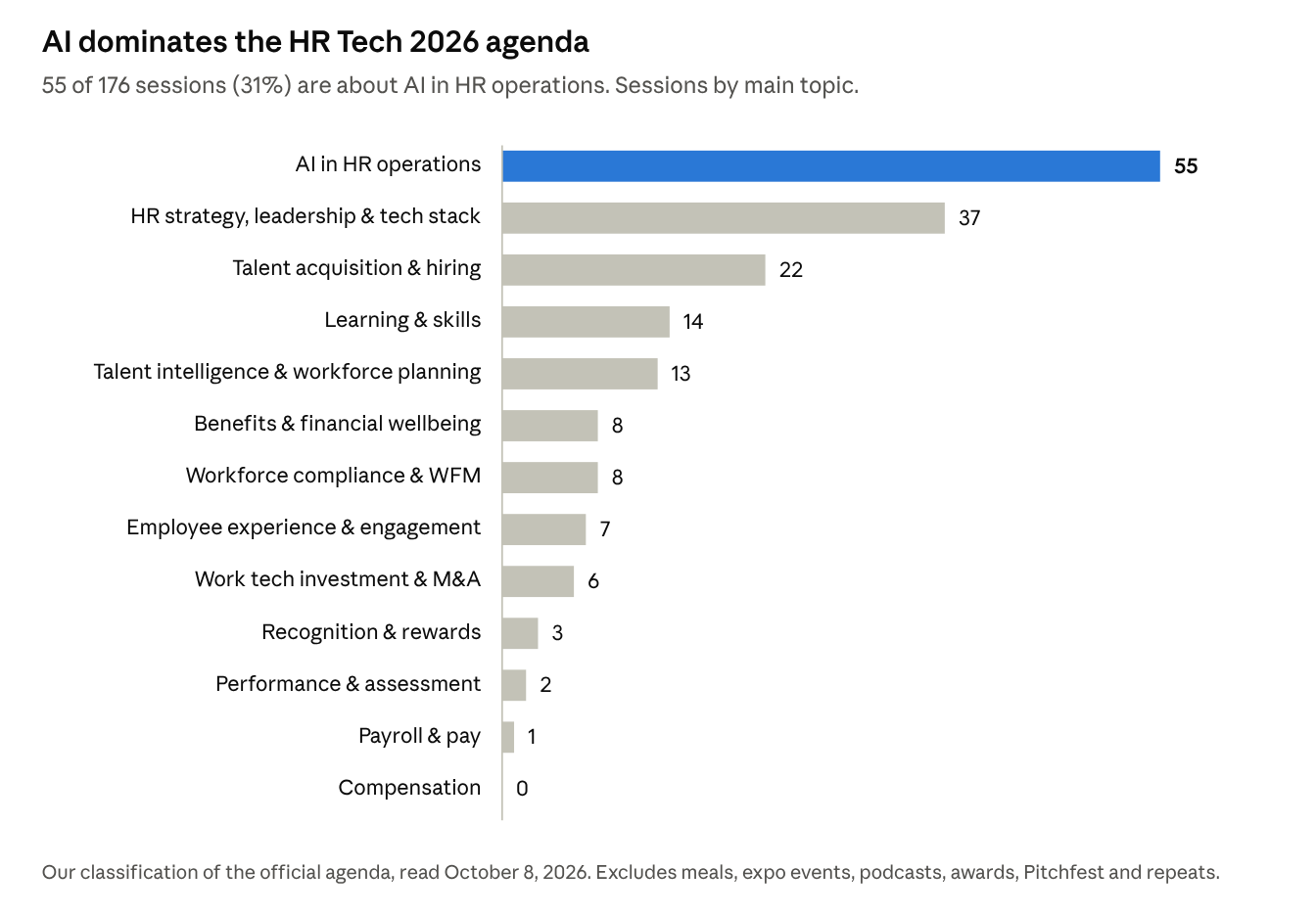
HR Tech 2026 official agenda, read October 8, 2026 · 176 sessions, sorted by main topic by us
What stands out:
AI is the agenda. Close to a third of sessions are about putting AI to work inside HR.
Hiring is the product category with the most stage time, including a keynote with Anthropic's head of people products.
Payroll, performance and recognition get six sessions between them. None has compensation as its main topic.
Investors have their own track, with sessions on funding and M&A.
Three themes in the keynotes and session topics
1. AI runs through every keynote. All four keynotes listed on the site mention AI in their descriptions. The closing keynote, from Prerna Ajmera, Microsoft's general manager of HR digital strategy and innovation, argues that the question is no longer how to implement AI but how to lead when the technology keeps changing. One of the new small-group programs is about putting AI into day-to-day HR operations.
2. A keynote on rebuilding hiring, not just speeding it up. One keynote pairs Mike Boufford, head of people products at Anthropic, with Tim Sackett, CEO of HRUTech.com. Its description says AI will force companies to reconsider the hiring process itself, including the reliance on resumes, credentials, and traditional recruiting metrics. Another keynote, from Tomas Chamorro-Premuzic, chief science officer at Russell Reynolds Associates, argues that AI will expose weak talent practices that were already there.
3. Return on investment and vendor consolidation are on the agenda. One of the six focus areas covers how to show the CFO the return on technology and people programs. Another promises sessions on vendor consolidation and budget constraints. A new small-group program is devoted to building the business case for HR technology.
Our read: some categories with a lot of capital get little time on the main stage. Compensation (60% Investor Backed) has no session of its own, and performance and feedback (51%) has two. For those vendors, the expo floor and side meetings will matter more. And with AI in almost every pitch, buyers will need a clearer way to compare vendors on what they actually do.
If buyers are consolidating vendors and asking for proof of return, we expect vendors to be compared more directly against each other. A company that was one of several tools in a category may now have to show why it should be the one that stays.
That makes two questions more important for any HR technology company: where do we stand against the companies buyers compare us with, and why?
A preview of the research behind this
These come from our own published market research, not from the conference.
Talent Acquisition Intelligence: capital is already concentrated. This covers North American firms whose main product is talent acquisition intelligence, fewer than 50 in all.
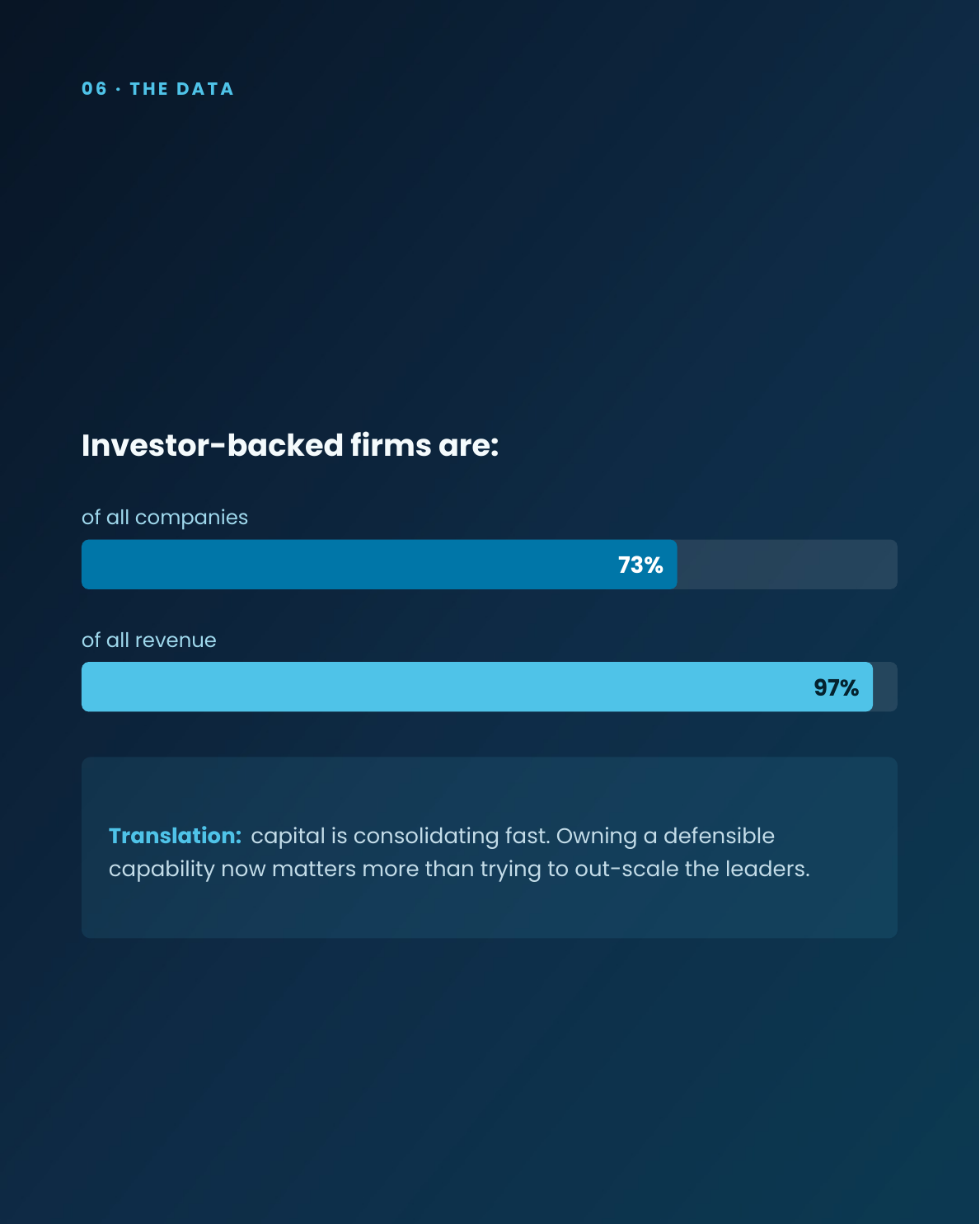
See the full Talent Intelligence breakdown.
Rewards & Recognition: vendors are buying vendors.
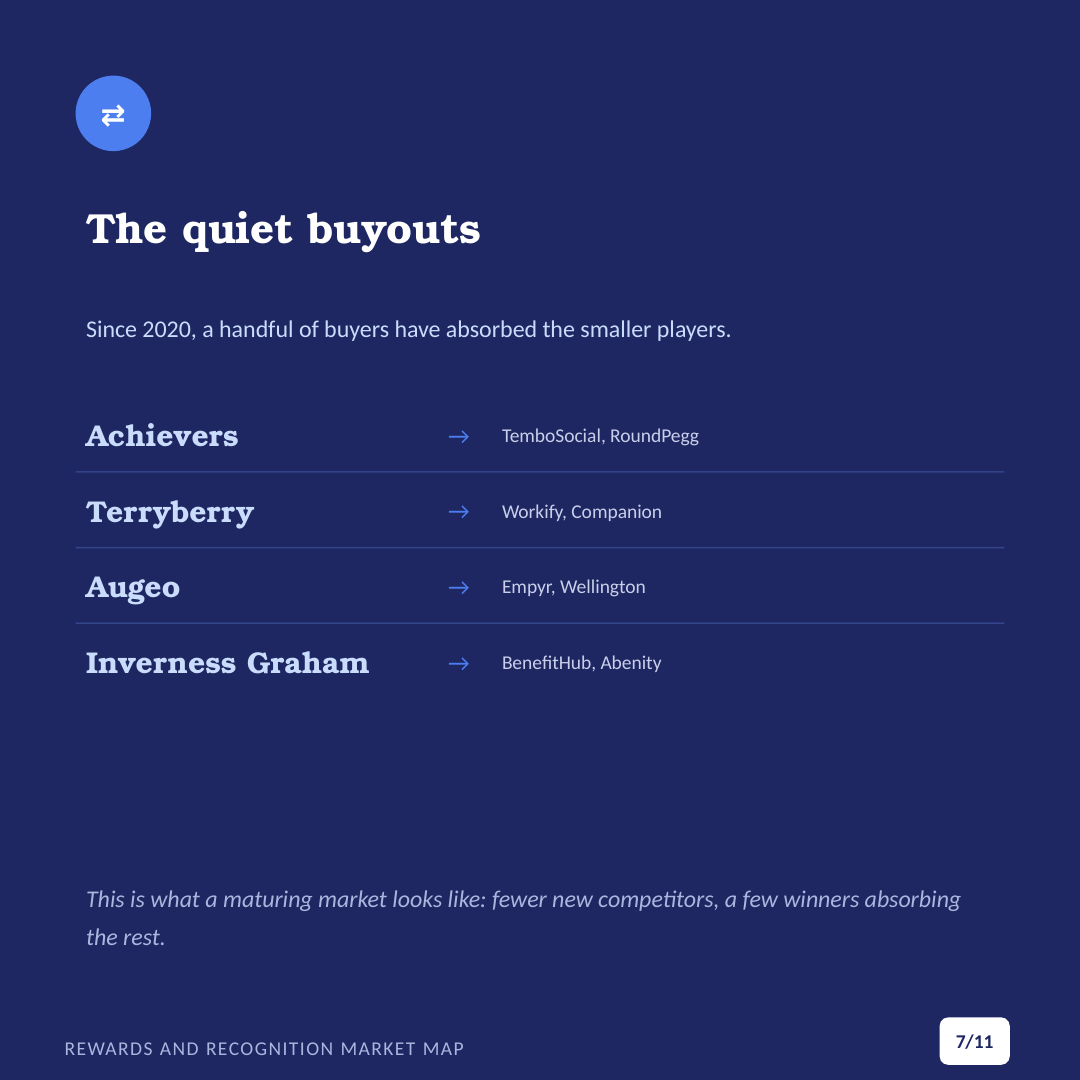
See the full Rewards & Recognition breakdown.
Performance & Feedback: vendors win on fit, not feature count.
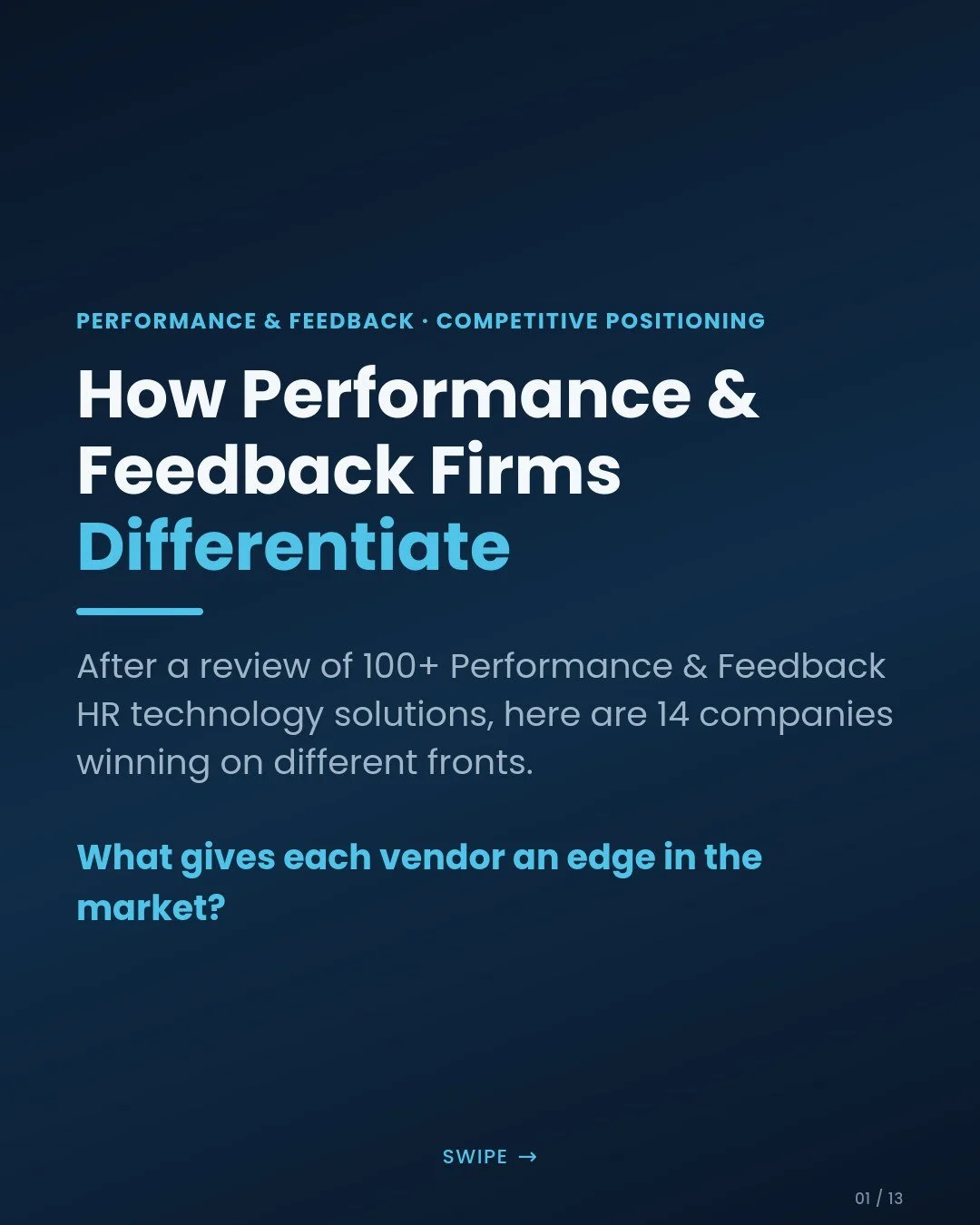
See the full Performance & Feedback breakdown.
The full market maps and company coverage are available on request.
What we do
In simple terms: we help Work Tech and tech-enabled companies see where they stand and what they are worth.
We map markets. We rank companies against their real peers, by ownership and revenue.
We track deals. We have tracked 2,000+ deal signals so far in 2026.
We explain why companies win. Our company scorecard looks at rank, competitive position, and how customers use a product.
We turn it into a plan. Valuation and benchmarking, corporate development strategy, and M&A support.
Let's meet at HR Tech
Heading to Las Vegas? We will be at HR Tech, October 20–22. Reply or message us to see where your company stands against its peers. After the conference, we will share what we heard and how it lines up with the agenda.
The expo runs October 20–22: Tuesday 5–7 p.m., Wednesday 9 a.m.–6 p.m., and Thursday 9 a.m.–2:30 p.m. (Pacific). Message us to set a time to meet. For the full schedule, see HR Tech's Agenda At-A-Glance.
Sources
Conference details: HR Tech 2026 home page. Agenda: HR Tech 2026 full agenda.
Keynotes and programs: HR Tech 2026 keynotes, session topics, and what's new in 2026.
Agenda chart and session counts: our classification of each session by its main topic, from its title and summary. It excludes meals, expo events, podcasts, awards, Pitchfest rounds and repeated sessions.
Investor Backed shares: our Talent Management Intelligence market map preview, May 2026 (Talent Intelligence, Compensation, Rewards & Recognition); our Talent Acquisition Intelligence mini market map, 2026; our Performance & Feedback mini market map, September 2026; our Employer of Record mini market map, March 2025; our Workforce Management (Aug 2026, 121 US firms with $5M+ revenue) and Learning & Development LMS/LXP (Aug 2026, 36 US firms with $5M+ revenue) company data from DealNet; our Benefits and Wellness market map, January 2024; our Payroll sector briefing, May 2024 (payroll software ownership count from March 2023).
Payroll, workforce compliance and Work Tech deal counts: Charles Bedard's Solve the Value briefings, October 7, 2026.
Preview slides and coverage links: our published posts, linked above.
Firm ages: our Rewards & Recognition market map (March 2026) and Talent Intelligence market map (October 2025). The Investor Backed figure covers the 35 Investor Backed firms in our Talent Intelligence company data.
Hiring examples: Paradox's Chipotle case study; Eightfold's home page. Paradox deal: Workday press release, October 1, 2025; price from Workday's August 2025 filing, as reported by Staffing Industry Analysts.
Our read on AI and HR data: our Talent Intelligence analysis, October 2026.
